Get Full Government Meeting Transcripts, Videos, & Alerts Forever!
Get email alerts on the Education K12 topic
No spam. Unsubscribe anytime.
Batavia Middle School outlines MTSS push, cites staffing strain and launches peer mediation pilot
Summary
Batavia Middle School administrators told the school board they are sharpening multi-tiered supports and PLC-driven instruction to address learning gaps and rising behavioral and mental-health needs, and announced a grant-funded peer mediation pilot involving 25 trained students.
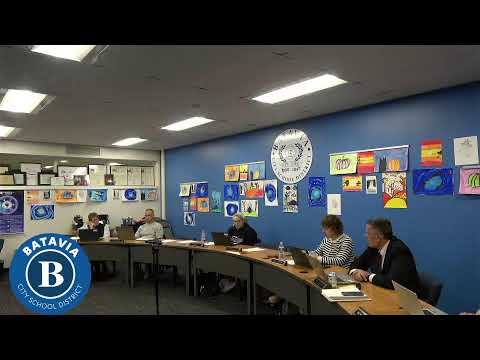
Batavia Middle School administrators told the Batavia City School District Board of Education that strengthening their multi-tiered system of supports (MTSS) and professional learning community (PLC) work is the district’s priority to address academic gaps and growing behavioral and mental-health needs.
Dr. Kreim, who presented Batavia Middle School’s update, said the school’s top goals this year are revising the master schedule, building PLC routines and expanding MTSS supports for attendance, academics, behavior and social-emotional learning. "We have 9 to 11 kids that are taking up 90% of our time," Dr. Kreim said, describing a small group of students with intensive needs that often draw staff away from broader supports.
Administrators outlined concrete steps: a master-schedule process with a draft by June 15 and finalized schedules by July 31; regular PLC cycles using power standards and multiple assessments; and tiered intervention plans with 4–6 week progress monitoring. Assistant Principal Christine Cameron said the MTSS team meets weekly, alternating building-level reviews with tier-3 individual-student meetings to develop next-level interventions and coordinate progress monitoring.
Administrators also described a new cell-phone policy they say has reduced in-school distractions: younger students keep devices in lockers while seventh- and eighth-graders turn phones in each morning. "That has drastically reduced just about any and all issue related to a cell phone," an assistant principal said.
To prevent conflicts, the school secured a grant to train peer mediators. Twenty-five students completed a three-day training and will pilot an in-school peer mediation program, which administrators said can give students a neutral peer forum for resolving disputes before they escalate.
On academics, fall I-Ready diagnostics show gaps administrators said require layered supports: 59% of students are on grade level in math while roughly 41% are two to three grade levels below; reading shows 47% at or above grade level and 53% two to three levels below. Administrators said I-Ready is one important measure but that a broader data profile with multiple measures will better guide interventions.
Board members asked how students are referred to MTSS (the RFA referral process) and whether parents are involved; administrators said the new process will be shared with families and that the team intends to add parent-facing referral access. Several board members pressed on staffing limits for counseling and special-education coverage; administrators said current staffing is being used in projections and that additional FTEs were not yet included in long-range financial projections.
The presentation closed with administrators emphasizing collaborative teacher work and community partnerships — including demonstrations by the Batavia Police Department — as central to creating a safer, more supportive climate for students.
The board moved from questions into other agenda items; no formal districtwide staffing action was adopted during the public session.