Strand Associates recommends staying on Lake Michigan and expanding service area to serve data center
Loading...
Summary
Strand Associates presented the water-supply-service-area plan required by NR 8 54, recommended remaining on Lake Michigan as the source and adopting Service Area 2 (including the data center area); presentation included demand scenarios and cost estimates for upgrades and potential plant expansions.
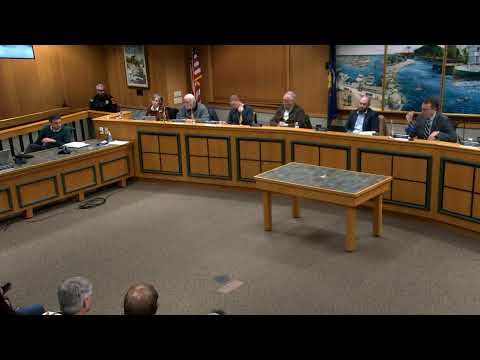
Strand Associates presented the City of Port Washington’s required water-supply-service-area plan during the Dec. 16 public hearing and recommended the city remain on Lake Michigan water and adopt Service Area 2, which includes the proposed data-center area and parts of the Town of Port Washington.
Ben Wood introduced Strand’s presentation and Sydney Morgan (project engineer) laid out DNR code NR 8 54 requirements. Strand reviewed three service-area alternatives and concluded that staying with Lake Michigan is least risky environmentally and most cost-efficient. The firm’s demand projections show the current water-treatment plant capacity at 4 million gallons per day (MGD) and estimated maximum-day demands of approximately 1.94 MGD in 2025, rising under certain scenarios to roughly 3.87–4.05 MGD by 2035–2045 if the conceptual full-site flows are realized; a wholesale arrangement that included the Village of Saukville could push demand above the current capacity and require plant expansion.
Strand noted a concept-level flow estimate provided earlier of 1.2 MGD for the full 1,700-acre site, but that Vantage’s site-specific plan for the first 680 acres shows an actual site-specific demand of about 20,000 gallons per day for phase 1 (a very small fraction of the concept total). The presentation included cost estimates: converting to groundwater wells would carry capital investment well above $55 million, a water-plant expansion from 4 MGD to 6 MGD was estimated at roughly $10 million, and replacement/new booster stations were estimated near $12 million.
Strand recommended Service Area 2 because it aligns with sanitary-sewer planning and accounts for near-term growth associated with the data-center site; the firm said additional refinements will follow as site-specific plans are completed. The written plan is posted on the city’s website and the city invited written comments to an email address provided during the hearing.
Council members asked clarifying questions about population thresholds and whether other utilities could serve the city; Strand confirmed neighboring systems lack adequate capacity and reiterated the plan’s 20-year planning horizon. The public hearing record was left open for written comments per normal DNR procedures.