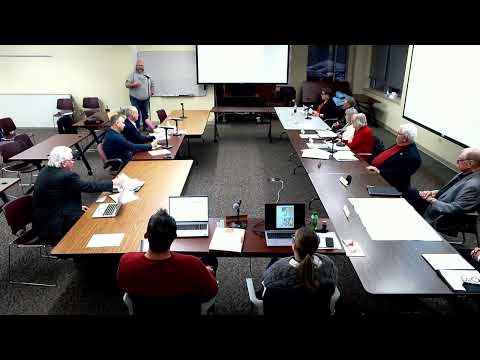
McHenry County board hears traffic, easement and neighborhood safety concerns over proposed slaughterhouse
Loading...
Summary
Neighbors, county transportation staff and planners debated a conditional‑use request for a 1.044‑acre slaughterhouse that would use a 33‑foot shared easement to reach Greenwood Road. DOT said a traffic memo/study and likely widening of the first 500 feet of access will be required; the board continued the hearing to Jan. 8 and requested the state's attorney weigh in on parcel interpretation.
McHenry County zoning officials on Dec. 24 heard hours of testimony over a conditional‑use petition to locate a food‑processing facility with animal slaughter on a 1.044‑acre portion of a larger agricultural parcel that would rely on a 33‑foot shared easement to access Greenwood Road.
Department of Transportation construction and permit engineer Keith McGraw told the board the county's review focuses on the change in traffic, potential backups onto Greenwood Road and the upkeep that increased use would require. He said the county has not yet received a traffic memo or study and that the petitioner is responsible for providing it. "We would ask the access path, the driveway be widened enough so two vehicles could pass for the first 500 feet off of Greenwood Road," McGraw said, adding that a hard surface would be required in the portion immediately adjacent to the county right‑of‑way and that turn lanes become a consideration once the study shows a major access threshold has been met.
McGraw described a practical example used in DOT review: at a certain volume of turning movements (about 50 trips in typical guidance), an access can become "major" and require turn‑lane treatments, though he emphasized exact thresholds depend on posted speed, average daily traffic and peak‑hour turning movements. He also said DOT would need to examine the original easement language and possibly consult the state's attorney if an owner of the underlying land claims the easement cannot be used for the proposed intensity of traffic.
The petitioner, represented by counsel Terry McKenna, argued easements are property rights that typically convey broad ingress and egress, and that historical farm and agritourism activity may predate modern permitting rules. McKenna said the question of whether an individual underlying property owner can block new uses will be a legal question for courts or the state's attorney. "Oftentimes, in these grants of easement, the grant is made for an even greater restriction," McKenna said, explaining his interpretation that the easement grants general access rather than narrowly defined activities.
Residents and organized opponents delivered repeated, detailed objections focused on safety, health and neighborhood impacts. Speakers described the access lane as narrow and dusty, noted Greenwood Cemetery sits along the easement, and recounted incidents in which funeral services were disrupted by passing U‑pick traffic. "It stinks to high heaven about three days out of the week," one nearby resident said of odors from on‑site animal operations, and several witnesses urged denial because of potential odor, flies, vermin and water‑quality risks to local wells and the Nippersink Creek watershed.
A real‑estate broker and other speakers cited studies and local examples suggesting property‑value declines near large animal operations; an opposition witness calculated an illustrative range of potential losses for nearby homes if nuisance impacts materialize. Opponents also pressed the petitioner on staffing, training and emergency planning; the petitioner said USDA inspection and guidance will apply and that employees would be trained, but opponents said many operational details and written plans were not yet submitted.
Planning staff planner Kim Charlo summarized the administrative record: the subject property is zoned A‑1 Agricultural and is part of three parcels totaling about 108 acres; the applicant seeks a variance to reduce minimum street frontage from 330 feet to zero because the conditional‑use area has no direct public road frontage. Charlo noted Section 16.56.030.HH of the county Unified Development Ordinance, which requires food‑processing facilities with animal slaughter to be at least 500 feet from any residential zoning district or residential structure in agricultural zoning. In the staff report Charlo said the applicant's documentation showed the nearest residential structure was "just over 217 feet" from the proposed facility, a measurement members of the public seized on as evidence of noncompliance.
That distance was later contested during discussion: Adam Wallen, director of planning and development, told the board the UDO defines a parcel by meets‑and‑bounds and that the conditional‑use area (the 1.044‑acre meets‑and‑bounds square on the site map) is the parcel from which staff measures compliance; he said that measurement produced an approximate separation that staff and planning had found consistent with the 500‑foot standard in their review (staff also discussed distances in the 700‑ to 900‑foot range in oral clarification). Because opponents and staff had differing emphases about how to interpret the ordinance language and the appropriate base parcel for measurement, the board asked the state's attorney to provide an opinion on the definition and measurement of "parcel" under county law.
No final vote was taken. The board continued the hearing to Jan. 8, 2026, for closing arguments and voting and asked staff to obtain the state's attorney's opinion on the parcel/measurement question and for the petitioner to provide any outstanding traffic memo or study and documentation about easement rights and potential agreements with easement owners.
What happens next: the board will reconvene Jan. 8 for closing arguments and a vote. The state's attorney's written guidance on how to interpret "parcel" for the HH (food‑processing/slaughterhouse) standard was requested and will be included in the record before the board votes.
Sources: Public testimony and staff report at the McHenry County Zoning Board of Appeals continuation hearing on Dec. 24, 2025.