Get Full Government Meeting Transcripts, Videos, & Alerts Forever!
Get email alerts on the Insurance Market topic
No spam. Unsubscribe anytime.
Senators Press DFS and Insurers Over Rising Home Insurance Costs, Seek Data and Relief
Summary
A joint Senate hearing scrutinized why residential property insurance premiums have jumped and coverage narrowed, pressing the Department of Financial Services on data, proprietary models, and discounting for mitigation while housing providers warned that soaring premiums threaten affordable housing.
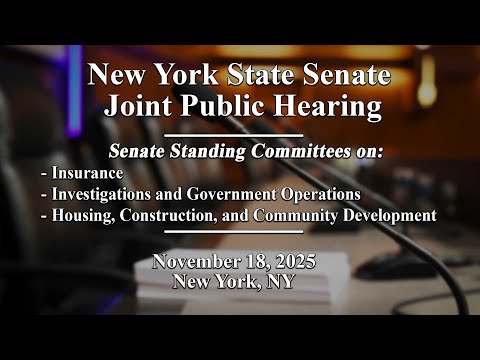
Lawmakers pressed regulators and insurers Thursday at a joint New York Senate hearing on why residential property insurance costs and deductibles have climbed sharply and why some homeowners and housing operators are losing coverage.
Acting Superintendent Caitlin Azro of the Department of Financial Services told the committee that climate-driven catastrophe frequency and severity, inflation in repair and labor costs, higher reinsurance prices and what regulators call social inflation in legal costs are the primary forces pushing premiums higher. "Extreme weather is the primary factor we are focused on," Azro said, adding that DFS has issued guidance on climate risk and on mandatory discounts for storm shutters and hurricane‑resistant glazing.
Senators pressed DFS on gaps in the regulator’s evidence, specifically whether DFS can access claims‑level data and the proprietary catastrophe models insurers use to set underwriting and rates. "If they are using climate models, we will review their approach," Azro said, but she warned regulators are still working through how to review proprietary models without harming competition. Several senators sought clearer rules so consumers know why their premiums rise and whether sliders such as flood, liability or reinsurance costs are being passed through to New Yorkers.
Industry witnesses including the New York Insurance Association and trade groups pointed to litigation, fraud, construction and replacement‑cost inflation and reinsurance pressures as the sources of market strain and urged more mitigation, fraud enforcement and regulatory capacity at DFS. "Affordability cannot be achieved without availability," said Cassandra Anderson of the state insurance trade group, while insurers said resilience investments and better data can lower long‑term costs.
Housing providers, including the city’s Housing Preservation & Development, and nonprofits representing affordable and supportive housing told senators that premiums have, in many cases, doubled or worse in a few years and said the increases are already forcing owners to draw down reserves, defer maintenance or consider selling. "Insurance has been the biggest increase for many housing providers," said Ahmed Degani, acting commissioner of NYC HPD, describing average annual increases nearing 25% in some preservation portfolios.
The hearing produced a convergence on priorities rather than an immediate consensus on one fix: committees called for (1) better, granular data on claims and rate drivers; (2) more transparency from insurers about models and discounts; (3) more active enforcement of nondiscrimination rules; (4) targeted funding for mitigation measures that insurers will credit; and (5) study or piloting of risk‑sharing tools — from captives to state reinsurance backstops — to stabilize hard‑hit lines and protect affordable housing.
The committees signaled plans to continue the investigation and to seek specific legislative or regulatory steps before the next session, including proposals to expand data collection, clarify how insurers must consider mitigation efforts in pricing, and explore short‑term financial relief for the most‑vulnerable housing providers and homeowners. The hearing record will inform those next steps.