Get Full Government Meeting Transcripts, Videos, & Alerts Forever!
Get email alerts on the Board Of Estimates topic
No spam. Unsubscribe anytime.
Baltimore committee debates Board of Estimates changes and moving procurement out of the charter
Summary
A Baltimore City Charter Review committee discussed proposals to alter the Board of Estimates’ composition and to strip prescriptive procurement rules from the charter, directing staff to research legal and fiscal implications and to prepare draft ordinance language setting new procurement thresholds.
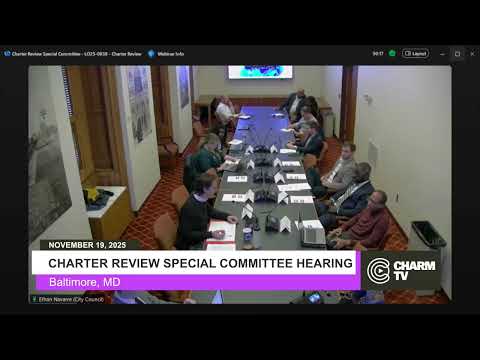
Baltimore City’s Charter Review Special Committee spent much of its session discussing whether to alter the Board of Estimates and to remove detailed procurement rules from the city charter.
Chair Bridal Dorsey opened the discussion by noting public interest in changing the Board of Estimates’ membership and in making procurement rules less prescriptive. Staff reported a public submission calling for elimination of the mayor’s two appointed members on the Board of Estimates so that the mayor, council president and comptroller would share authority more equally. Committee members said the suggestion reflects a long‑running debate over how much control the mayor’s office holds through BOE votes.
Members repeatedly asked staff to gather comparative and legal research before pursuing any amendment. Counsel and several members highlighted two distinct questions: what the charter requires BOE to do now, and how alternative structures would affect the city’s budget and procurement practice. A participant advised the group to check whether proposed changes could affect bond issuance or ratings; others said that concern should be tested by evidence rather than treated as an automatic barrier.
A related thread focused on moving procurement language out of the charter and into ordinance so thresholds could be adjusted without a ballot referendum. The committee discussed a procurement‑transformation plan the mayor’s office provided that would remove many procurement specifics from the charter and set administrative thresholds (discussion referenced a draft approach where items below roughly $250,000 would be handled administratively and larger procurements would continue to go to BOE review). Chair Dorsey said removing “overly prescriptive procurement requirements” from the charter is likely to have general consensus and asked staff to produce a concrete proposal for the committee to debate before introduction.
Members agreed on next steps: staff were asked to assemble background materials showing what BOE currently must do under the charter, how comparable jurisdictions handle procurement and BOE‑like functions, and what legal or fiscal implications (including any state‑law constraints) would follow from different reform options. The committee scheduled follow‑up work and asked procurement and finance staff to brief the group at a later meeting.
The committee did not vote on any amendment; it directed staff research and drafting as the next procedural steps.