Get Full Government Meeting Transcripts, Videos, & Alerts Forever!
Get email alerts on the Housing Options And Opportunity topic
No spam. Unsubscribe anytime.
Baltimore committee closes public testimony on mayor-backed housing bill, vows more work sessions
Summary
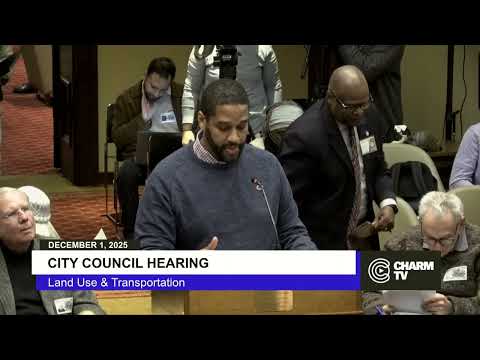
After roughly an hour of public testimony split between strong opposition and support, the Land Use and Transportation Committee closed comments on Council Bill 25-0066 (Housing Options and Opportunity Act) and agreed to continue work sessions to consider amendments including reporting and a narrower conversion review process.
The Land Use and Transportation Committee on Dec. 1 closed public testimony on Council Bill 25-0066 — the mayor’s Housing Options and Opportunity Act — after roughly an hour of in-person testimony and opened a period of work sessions to refine amendments and data requirements before making a recommendation to the full City Council.
Chair Ryan Dorsey reiterated that the committee would not vote on the bill that day but would use future work sessions to try to resolve points of disagreement. The bill, introduced in May as part of a five-bill package, would expand where two-to-four unit homes are allowed and change conversion rules that currently limit multifamily development in much of the city’s residential zones.
Opponents who testified described the package as rushed and unevenly applied. Michael Scott, a resident, said the bill “is another experiment being run on the backs of Black neighborhoods,” arguing that historically Black middle-class blocks lack the private covenants and enforcement capacity that protect other areas. Multiple speakers, including community organizations, urged additional studies (health, environmental, public-safety and economic impact) and criticized the mayor’s public materials and interactive mapping for using approximations without adequate local analysis.
Speakers citing data warned of much higher densities if fourplexes were permitted widely. Joan Floyd, summarizing numerical analysis, said allowing fourplexes on small lots could generate multifamily densities “higher than the IMU, the OR, even higher than the TOD-1 zone,” and called for caution about imposing such intensities on rowhouse blocks.
Supporters and some committee members framed the bill as a tool to address shortages and increase housing options. Councilman Zach Blanchard said smaller units can be more affordable and urged complementary measures — rental licensing, parking management and incentives for owner-occupied conversions — to mitigate harms. Councilman Mark Parker (identified in debate as a sponsor of targeted amendments) said he opposed the bill in its present form but is working on amendments to limit negative outcomes and make the proposal a usable policy tool.
The mayor’s office representatives told the committee they support the bill’s goals but want to continue discussions to produce a version with broader support. The administration also submitted an amendment package discussed at the meeting that would: make two units allowed by right while sending three- and four-unit conversions to the Board of Municipal and Zoning Appeals (BMZA) for conditional-use review, and add reporting and study requirements.
Committee members and agency staff discussed specifics of the proposed reporting. The administration outlined two related reporting requirements under consideration: an annual BMZA report listing approvals and denials of conditional-use conversions (and reasons for denials), and a triennial report by the planning director (with DHCD) documenting multiunit buildings constructed or converted, units and unit sizes, locations by neighborhood/council district, and a recommendation for whether to continue or modify the low-density multifamily allowance. Members asked that the reporting also track unit rents or sale prices and the owner-occupied vs. investor-owned mix for newly created units.
Agency testimony addressed implementation capacity. Housing Commissioner Kennedy said DHCD was actively hiring and expected to reach roughly 71–72 inspectors, with more than 60 positions already filled, and described steps to separate sanitation inspections to improve response. Several committee members said enforcement capacity and code-inspection resources must be aligned with any expansion of by-right conversions.
Chair Dorsey framed the debate in structural terms, saying the zoning framework historically reinforced segregation and that modest changes to where housing types are allowed could expand opportunities across neighborhoods. Vice Chair Sharon Green Middleton and others urged slower, more inclusive engagement with communities most likely to be affected.
The committee closed public testimony and directed staff and members to continue working — refining amendments, confirming statutory and drafting issues raised by the law department, and shaping reporting and monitoring language — before deciding whether to recommend the bill to the full council.