Get Full Government Meeting Transcripts, Videos, & Alerts Forever!
Get email alerts on the City Budget topic
No spam. Unsubscribe anytime.
Capitola city manager warns of mid‑term budget gaps as pension and sales‑tax pressures mount
Summary
City Manager Jamie Dolcey told a town‑hall audience that Capitola’s $23 million budget faces mid‑term deficits driven chiefly by volatile sales‑tax revenue and rising CalPERS pension payments; staff outlined reserves, past actions and options to close future gaps.
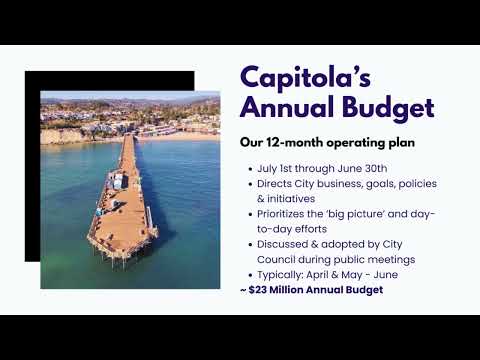
City Manager Jamie Dolcey told residents at a Nov. 20 town hall that Capitola faces mounting fiscal pressure from two long‑running forces: the volatility of sales‑tax receipts and increasing pension costs. “We’re at a $23,000,000 annual budget at this point,” Dolcey said, and noted that sales tax is the city’s largest and most variable revenue source.
Dolcey emphasized that sales tax can swing widely year to year and that Capitola receives only a small share of the total taxes generated inside its limits, meaning local economic shifts and tourism cycles can materially affect municipal revenues. He said sales tax growth has lagged inflation over the last 15–20 years, reducing the city’s purchasing power by roughly $3 million in constant dollars since 2006.
On pensions, Dolcey said the city’s unfunded accrued liability to CalPERS climbed from under $1 million in 2011 to “north of $3,000,000” today, a legacy cost tied to past assumptions and benefit changes. That liability, he said, is a fixed obligation that must be paid regardless of future staffing levels. The city’s reserves, which fell to about $500,000 during the post‑recession period, have been rebuilt to nearly $6,000,000, Dolcey added.
Staff presented a five‑year projection that shows potential deficits materializing around fiscal year 2029, driven primarily by pension payments and conservative sales‑tax growth assumptions. Dolcey walked through the city’s revenue mix—sales tax, property tax, transient occupancy tax (TOT, retained fully by the city), fees for services and grants—and highlighted tradeoffs in policy responses, including seeking new revenue via voter measures, pursuing economic development to boost revenue‑generating uses such as hotels and commercial space, and adjusting service levels or fees.
Dolcey and other staff said the council has used a combination of measures in the past—tax measures approved by voters, parking‑rate adjustments, the cannabis tax and targeted economic development—to shore up finances, and that similar options remain on the table. No formal fiscal actions or votes were taken at the meeting; staff framed the budget outlook as background for future council and community discussion.