Get Full Government Meeting Transcripts, Videos, & Alerts Forever!
Get email alerts on the Parks Recreation Open Space topic
No spam. Unsubscribe anytime.
Kenmore planning commissioners continue PROS plan review, focus on funding options and wording ahead of council transmittal
Summary
At its Dec. 2 meeting the Kenmore Planning Commission continued review of the Parks, Recreation and Open Space (PROS) plan implementation chapter, debating funding strategies (impact fees, REET, levy lid lift, possible Metropolitan Park District), progress-assessment cadence and transmittal letter language to City Council.
Kenmore Planning Commission members continued deliberations on the implementation chapter of the city's Parks, Recreation and Open Space (PROS) plan at a Dec. 2 meeting, focusing on how the plan frames funding options and whether the document reads as a set of options or a prescriptive recommendation.
Tom Beckwith, the plan consultant, opened the discussion by reminding the commission that "we're not looking for a recommendation. We are continuing the discussion from the last meeting," and walked commissioners through the implementation tasks, financing scenarios and appendices included in the draft.
Why it matters: the PROS plan must show a financially feasible path for the capital facilities program to meet state grant eligibility requirements while also making clear what the planning commission is (and is not) recommending to City Council. Commissioners repeatedly stressed that the document should remain an inventory of options and feasibility analysis rather than a binding list of projects the city must build.
Key facts and proposals
- Funding scenarios: Beckwith summarized three financing alternatives modeled in Appendix F, using combinations of park impact fees, REET allocations and a potential levy lid lift to fund about $40 million of acquisitions and projects included in the CFP. He said the analysis shows the package is "economically feasible." Commissioners asked whether any scenario could avoid new tax measures if the recreation center or other large-ticket CFP items were removed from the plan.
- Impact fees and accountability: Commissioners were reminded that impact fees must be held in dedicated, auditable accounts and are typically expended within six years for the area that generated them. Beckwith said impact fees, REET and levies are among the least controversial conventional tools for financing parks.
- Levy limits and levy lid lifts: The commission discussed statutory constraints on property tax rates and how combined junior taxing districts affect local capacity. Beckwith explained how a levy lid lift would reset a jurisdiction's base for the 1% annual increase and that voter approval would be required for increases that exceed statutory limits.
- Metropolitan Park District (MPD) and overlap concerns: Commissioners asked whether creating an MPD would duplicate services provided by the existing North Shore Park & Recreation entity. Beckwith said the legal answer depends on the voter-approved language that formed the existing district and that an MPD may be possible if it does not duplicate the earlier district's authorized purposes; commissioners noted political sensitivity among neighboring jurisdictions.
- Wording and cadence: The group debated "may/consider" versus "will/adopt" phrasing across tasks. For task 11 (progress assessments), commissioners favored building flexibility into the language but asked that the plan recommend a periodic check-in (roughly a three-year midpoint) while acknowledging the required full PROS update aligns with the city's multi-year schedule.
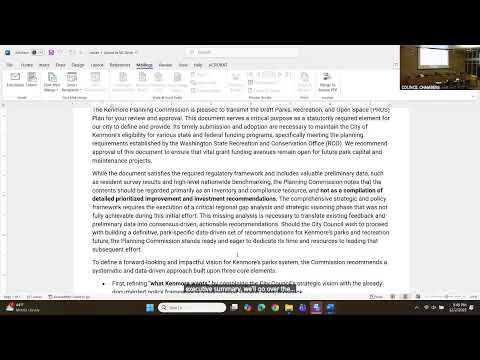
- Executive summary and transmittal letter: Staff presented two executive-summary drafts (a concise "cliff notes" option and a longer version). Commissioners expressed broad support for the concise version up front, with supplemental material in appendices, and asked for a transmittal (cover) letter to City Council that clarifies the plan is a compliance and feasibility document rather than an integrated recommendation of specific projects. Commissioner LaSalle and Commissioner Olsen volunteered to draft that transmittal text and circulate it to staff for distribution to the full commission.
Votes and formal actions
- The consent calendar was moved by Vice Chair Thompson and approved unanimously at the start of the meeting.
Next steps
Commissioners asked staff to circulate revised executive-summary language and the draft transmittal letter; LaSalle and Olsen will prepare the initial transmittal draft to be reviewed at the commission's Jan. 6 meeting. Staff indicated the commission's recommendation and the PROS plan are scheduled for City Council presentation on Jan. 26. The meeting was adjourned at 9:51 p.m.
Quotes
"We're not looking for a recommendation. We are continuing the discussion from the last meeting," Tom Beckwith said as the evening's framing.
Vice Chair Thompson moved approval of the consent calendar: "I move the consent calendar, for approval." The chair declared the consent agenda approved unanimously.
"The answer is yes, it is economically feasible," Beckwith said when asked whether the funding scenarios would support the CFP as presented.
Context
The PROS plan is a statutory element used to qualify jurisdictions for certain state and federal grant programs. Commissioners said the plan should enable future grant eligibility while making clear that many specific project decisions and financing choices remain for City Council and future project-level reviews.
Reporting note
Quotes and attributions come from the meeting transcript of the Kenmore Planning Commission meeting on Dec. 2; attributions use the names and roles as they appear in the record.