
Mid Kings River GSA adopts groundwater allocation policy amid limited state contact
Get AI-powered insights, summaries, and transcripts
Sign Up Free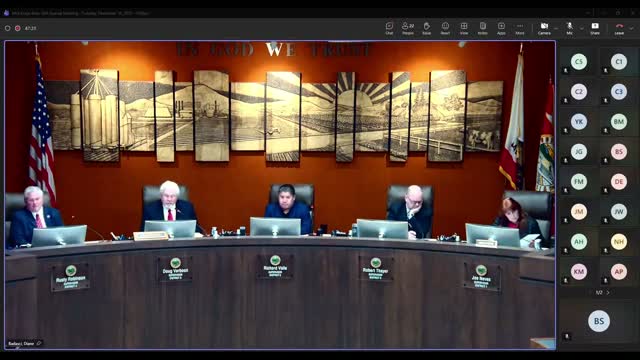
Summary
The Mid Kings River Groundwater Sustainability Agency adopted a resolution establishing an initial groundwater allocation policy on Dec. 16, 2025, by a 5‑0 roll call (one member absent), while staff and board said state agencies have largely declined to meet because of ongoing litigation.
The Mid Kings River Groundwater Sustainability Agency voted unanimously (5‑0, one absent) on Dec. 16 to adopt a resolution establishing an initial groundwater allocation policy that sets how pumping allocations will be calculated and administered.
Consultant Amir Hussain, who led the staff presentation, told the board the policy reflects more than 90 public comments and two workshops held during a 45‑day outreach period. "We took all the comments, we logged them, we reviewed them with the stakeholder committee," he said, noting changes that clarify there is no opt‑out for pumpers who use more than 2 acre‑feet per year and that fallowed (non‑irrigated) parcels will be zeroed out of ET‑based calculations.
Why it matters: the allocation policy sets limits and processes that will shape irrigation and water‑use choices for growers and other pumpers in the Mid Kings River GSA over the coming years. Board members and consultants said the GSA adopted an initial, adjustable policy with the expectation it will be revised as monitoring and mitigation programs develop.
The meeting highlighted a complicating factor: limited communication with state regulators. Hussain said the injunction tied to a Kings County Farm Bureau lawsuit had been lifted, "but due to the litigation ... they will not be meeting with us at this time." He added, "We don't even know if they would review [a plan]" if submitted now, a constraint the board cited repeatedly when discussing assumptions and contingency plans.
Board action: Chair called for the motion to adopt the allocation policy; Supervisor Rusty Robinson moved the resolution and Supervisor Robert Thayer seconded. The clerk recorded aye votes from Richard Vallee, Deborah Boone, Rusty Robinson, Robert Thayer and Kimber Regan; one member, Joe Nebs, was absent. The resolution was adopted.
Context and next steps: consultants said the allocation policy is one element of the groundwater sustainability plan (GSP) work stream. Staff expect to finalize policies and a draft GSP in coming months and to continue stakeholder outreach, including up to a dozen workshops tied to different outreach campaigns. Consultants also said the GSA will pursue RFPs for a well registry platform, well mitigation services and outreach support.
Quotes: "We took all the comments," Hussain said summarizing revisions; later he told the public, "We base this on the best information we have to date, and we are comfortable that we can defend these values to the state." Resident Dan Fizer cautioned that the state could still reject the adopted numbers, asking at one point if the state could come back and require lower allocations; staff replied the state could require modifications if the plan failed to meet requirements.
What remains unresolved: the GSA adopted the policy as a working document but acknowledged several open items — notably how the state will review or enforce the plan given limited communications, and how allocation coordination across neighboring GSAs will be handled. Staff said they will continue to engage neighboring GSAs and the stakeholder committee and will return with operational details and any suggested revisions.