Get Full Government Meeting Transcripts, Videos, & Alerts Forever!
Get email alerts on the Ems Feasibility topic
No spam. Unsubscribe anytime.
Study: Elyria could run municipal ambulance service but it would take years and millions
Summary
A consultant told Elyria council a fire‑based municipal EMS program is operationally feasible and could improve response times, but startup costs are estimated at $2.5–$3.5 million and implementation would take multiple years; council agreed to form a study committee in 2026.
A consultant hired by the city told Elyria council on Nov. 24 that the city could operate its own ambulance service, but doing so would require significant up‑front spending and a multi‑year transition.
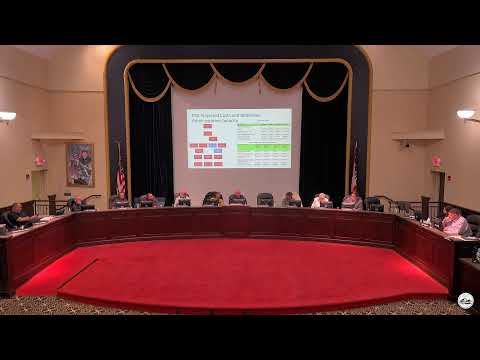
Steve Knight of Fitch & Associates presented a feasibility study that compared the current private ambulance contractor (Life Care) and the Elyria Fire Department. Knight said Elyria’s 90th‑percentile travel time is about 6.5 minutes and Life Care’s is about 7 minutes, placing both agencies in a similar performance range. He said industry research shows the greatest survival benefits occur for high‑risk patients when responders arrive in five minutes or less, and that marginal improvements beyond the 90th percentile produce diminishing returns.
Knight said the study modeled several deployment options. Maintaining the status quo with improved contractual transparency and an additional Life Care unit would be one option; a fire‑based municipal model would require buying ambulances and adding staff. ‘‘If you wanted to deploy from the three fire stations like your typical fire department model is today, then we’re recommending you need five ambulances 24 hours a day to cover the system really, really well,’’ Knight told the council.
The report estimated start‑up costs between about $2.5 million and $3.5 million depending on the number of units and reserves. Recurring operational scenarios ranged from a modest net positive contribution to the general fund in some configurations to near break‑even in the most expansive deployment; Knight estimated roughly $4.2 million in net revenue is available in the community based on payer mixes and collection assumptions, and noted Medicare and Medicaid are the largest payer groups.
Elyria fire and council members probed the analysis. Knight said the study aggregated data across seasons and conditions and therefore implicitly accounts for variable traffic and weather: ‘‘It encapsulates all of those events both up and down,’’ he said in response to a question about how travel times were calculated.
Council members voiced differing priorities: some urged caution because of the cost and time needed to implement a municipal system, while others said the potential for improved response and a roughly $1.2 million estimated net positive in some scenarios merited further study. Council members asked that the findings not ‘‘gather dust’’ as prior studies had and urged creation of a citizen‑staff committee to develop concrete next steps.
Council consensus at the end of the discussion was not to act immediately but to form a committee in early 2026 to examine the operational, fiscal and facility implications and return recommendations to the council. The committee’s membership and timeline will be set through strategic planning in the coming months.
Next step: the council plans to form a committee in 2026 to study the report in detail and report back with recommendations and cost estimates.