
CalPERS keeps 6.8% discount rate; actuarial assumption updates raise modest contribution expectations for some plans
Get AI-powered insights, summaries, and transcripts
Subscribe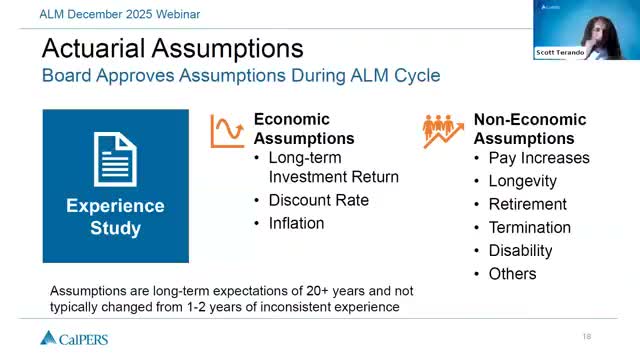
Summary
CalPERS confirmed a 6.8% funding discount rate and adopted modest actuarial assumption changes — including raising inflation to 2.5% and salary‑scale adjustments — that staff project will slightly reduce funded status and modestly raise required contributions for many plans; PEPRA impacts are concentrated and timing of changes was detailed.
CalPERS staff told stakeholders the board confirmed a 6.8% discount rate for funding valuations while adopting modest actuarial assumption updates that will slightly raise contribution expectations for many plans.
Chief Actuary Scott Turandell summarized the actuarial experience study, saying the valuation discount rate remains "6.8%" and that staff raised long-term price- and wage-inflation assumptions from 2.3% to 2.5% to reflect recent inflation dynamics: "we felt we needed to bring up our current assumptions at least at 2.5%." He said most demographic assumption changes were small (a slight reduction in projected mortality rates and some consolidation of disability assumptions), but salary-scale adjustments (merit and longevity) were a larger influence in many plans.
Scott presented sample contribution impacts: for a classic 2% @ 60 miscellaneous formula, staff estimate a minimum impact of about 0.1%, a median of about 0.3% and a maximum about 0.9%. He said funded-status projections would decline slightly — about 0.3 percentage points for 2024 and roughly 0.4 for 2025 — and cautioned that final employer contribution rates depend on each plan’s valuation and the eventual return experience.
On member-level impacts, staff said PEPRA-member changes are limited for miscellaneous plans ("9 plans out of over 1,400 plans being impacted," staff said, and "definitely less than right around less than 2% of the members"), whereas safety plans and members are more affected (staff estimated roughly two-thirds of safety plans and two-thirds of safety members could see contribution changes).
Timing: Scott said the new assumptions will be used for the June 30, 2025 valuations and that contribution-rate impacts will appear in fiscal year 2027–28 for public agencies and 2026–27 for state and school employers. He also noted that option factors and service-purchase calculations will apply to retirements occurring on or after Nov. 20, the date staff set for the new factors to take effect.
Staff directed stakeholders to the Pension Outlook tool on the CalPERS website to model agency-specific impacts and said the tool would be updated shortly with the new assumptions and with the Board’s finalized returns for modeling.