Get Full Government Meeting Transcripts, Videos, & Alerts Forever!
Get email alerts on the Public Safety Technology topic
No spam. Unsubscribe anytime.
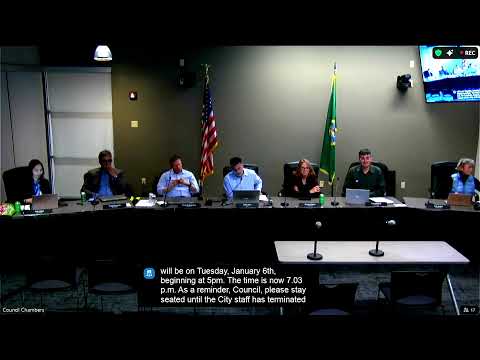
Council pauses Flock ALPR pilot, reallocates funds and authorizes DVR and evidence system procurement
Summary
After extensive public comment about privacy and data-sharing, Mercer Island's council voted to pause a stationary Flock ALPR pilot and reallocate $15,000 toward new in-car camera equipment; the council also authorized the city manager to procure an in-car DVR system and digital evidence management system and appropriated $85,710 from reserves.
The Mercer Island City Council voted to pause the stationary Flock automated license-plate-reader (ALPR) pilot and to reallocate $15,000 from that pilot toward procurement of in-car digital video recording equipment. Separately, the council authorized the city manager to negotiate and execute a service agreement for a new in-car DVR system and cloud-based digital evidence management system and appropriated $85,710 from the police in-car camera replacement reserve and the technology and equipment fund.
Management analyst Carson Hornsby told the council staff had coordinated with Flock representatives but that new information — including a University of Washington report noting federal access to Flock data and a recent Skagit County court ruling classifying Flock images as public records — prompted the recommendation to pause the pilot. "So given all of this information, the city manager has made a recommendation to pause the Flock pilot program, and reappropriate the $15,000 from this project towards a new in-car DVR system and additional evidence management system," Hornsby said.
Public comment before the vote was substantial and largely opposed to stationary ALPRs. Speakers raised privacy and immigration-enforcement concerns and cited public-records rulings. Kian Bradley urged the council to amend vendor agreements or pause deployment, saying, "Giving a private company unfettered surveillance access is not a good idea." Eric Dubovsky called ALPRs "warrantless dragnet surveillance" and questioned their effectiveness relative to impacts on residents. Sarah Karim described fears voiced in an immigration-focused listening session and said ALPRs could "threaten their ability to live freely, to move without fear." Addie Smith separately used the public-comment period to accuse local police of refusing to take reports after alleged racially motivated harassment; she said she was arrested after defending herself and accused the city of suppressing hate-crime complaints.
Chief (Bennett) commented on technical differences between systems, describing Flock as premised on data-sharing while patrol-car ALPRs match local hit-lists. "The premise of Flock cameras is data sharing, where the premise of LPRs within the patrol vehicles are just matching against hit lists," the chief said. After council discussion, a motion to place the Flock pilot on hold and reappropriate the pilot funding passed on a roll-call vote with Aye votes recorded. The subsequent motion to authorize procurement and the $85,710 appropriation also passed on roll-call vote.
The council directed staff to return with detailed procurement documents and a separate agenda item on automated parking enforcement in early 2026. The Flock pilot remains paused pending further analysis and legal/policy developments.