Get Full Government Meeting Transcripts, Videos, & Alerts Forever!
Get email alerts on the Education Budget topic
No spam. Unsubscribe anytime.
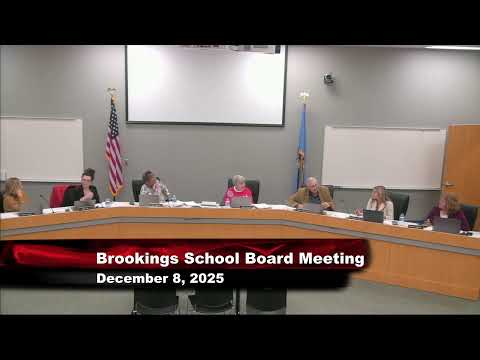
Superintendent outlines state budget risks and potential funding options for Brookings schools
Summary
Superintendent Dr. Schultz walked the board through key items in the governor's budget address — special education recategorization, a reported $15 million decrease in general education funds, proposed state reserve changes, and one-time sources such as unclaimed property — and warned rising insurance and utility costs could force difficult district choices.
Superintendent Dr. Schultz gave the board a detailed briefing on the governor’s 2026 budget address and what it could mean for the Brookings School District.
Dr. Schultz cautioned against conflating two separate figures: a statutory index-based increase (which she said would be 2.9% under the index factor) and a separate $15,000,000 reduction shown in the general education line of the budget. "That 15,000,000 has nothing to do with what we're supposed to be getting paid," she said, explaining the $15 million figure reflects budget reallocation rather than a straightforward cut tied to enrollment declines.
She explained special‑education categories are re‑calculated every two years and said recategorization accounts for roughly $2,800,000 in the proposal. Dr. Schultz also outlined possible advocacy points: asking the legislature to consider drawing from a higher than planned state reserve (the governor proposed raising reserves from 10% to 12.5%), reconsidering portions of a prior sales‑tax measure, and seeking one‑time funds such as unclaimed property (she cited roughly $63,000,000 in unclaimed property this year) or unspent Department of Education allocations.
Dr. Schultz highlighted district‑level budget pressures tied to benefits cost: "the district pays, between the district and the employees, it's about a $5,000,000 expenditure," and said health and insurance increases combined with flat salary assumptions could force the district to look at staffing reductions because roughly 80% of the budget is staff costs.
Locally, she noted Brookings has fared relatively well on enrollment compared with many large districts, but the district is continuing boundary work and earlier kindergarten registration to firm up staffing projections. The administration will publish a stakeholder survey and hold community sessions to inform long‑range facility planning, with a particular emphasis on the high school science area, roofing, and replacement of aging air‑handler units.
Board members thanked Dr. Schultz for the overview and discussed advocacy steps the district can take with legislators and the community as the state budget process moves forward.
What’s next: the board encouraged advocacy to the legislature and requested staff follow up with clearer cost estimates for district impacts and options to protect instructional programs.