Get Full Government Meeting Transcripts, Videos, & Alerts Forever!
Get email alerts on the Environment Wetland Restoration topic
No spam. Unsubscribe anytime.
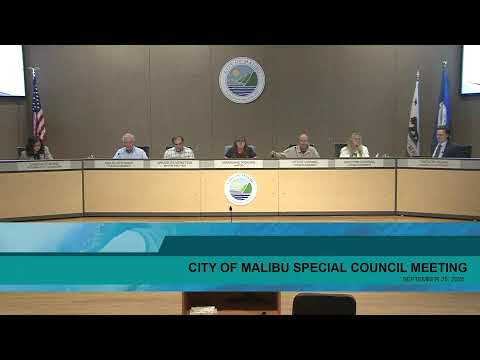
Malibu council hears heated appeals over Civic Center wetland; property owner withdraws restoration permit
Summary
At a Sept. 25 special meeting, residents and two appellant groups urged full restoration of a Civic Center Way wetland and enforcement of local LIP protections; the property owner said it would restore a 100-foot buffer per staff direction but announced it was withdrawing its Coastal Development Permit application late in the hearing.
The Malibu City Council met in a Sept. 25 special session to hear two cross-appeals of Planning Commission Resolution 24-13 tied to Coastal Development Permit 22040 for 23955 Civic Center Way. Appellant groups — the Malibu Township Council and the Malibu Coalition for Slow Growth — urged the council to require broader restoration and protections after years of unpermitted disking, saying older delineations show a larger wetland footprint than the applicant and a recent delineation indicate.
"This Eshera parcel is a rare ecological treasure," said Pat, an appellant speaker, urging the council to direct restoration on the basis of earlier Edith Reed delineations and to require the LIP's 3:1 restoration ratio for illegally disced areas. Appellants showed photos and video they said documented wholesale clearing in 2019–2020 and pressed the council to treat the historic, pre-disked boundary as the baseline for restoration.
The owner’s counsel, Victor Dela Cruz of Manette Phelps, said the current owner bought the property in June 2021 and promptly filed a habitat restoration and monitoring plan (HRMP) in July 2022 at the city biologist’s direction. "We applied to do exactly what city staff and the Coastal Commission asked: restore the 100-foot wetland buffer," he said, adding that his client would not sign an approval requiring a 150-foot buffer or a delineation that "is based on politics rather than science." The applicant also noted that a 2024 update to the GLA delineation formed the basis of the city-approved boundary and that remediation work within the 100-foot buffer would be expensive.
City staff and consultants presented a complex record of competing wetland studies. Staff summarized prior delineations (Edith Reed reports from 1998 and 2018, a GLA study from 2019 updated in 2024, and a Lucas delineation) and told council members that the city biologist had reviewed recent work and that staff had no single recommendation for council. Staff noted the city’s LIP defines wetland and buffer standards and that an expanded buffer was the Planning Commission’s discretionary choice aimed at increasing restoration acreage.
Residents and birders described longstanding wildlife use and urged the council to adopt the largest delineation on record. "This wetland is the last living wetland in Malibu," said Colin Drummond, who submitted video and photographs documenting birds and marsh habitat. Public comment repeatedly urged that the council either require full- parcel restoration or at least adopt older delineations cited by plaintiffs, and several speakers urged enforcement action against the party that carried out the earlier disking.
Council members pressed staff on legal and technical issues, including whether a prior code enforcement notice was discoverable by a purchaser, how the Coastal Act and city LIP apply to restoration versus new development, and whether the 3:1 mitigation ratio applies to the city's situation (staff and applicant argued it generally applies to new development that includes dike/fill, while appellants argued it should apply when illegal removal of habitat has occurred).
Public Works responded to questions about a stormwater inlet at Stewart Ranch Road and Civic Center Way, explaining that drainage infrastructure captures overflow only when sheetflow exceeds historical thresholds and that the system was not intended to drain the mapped wetland under ordinary conditions.
Near the end of the four-hour hearing the applicant announced it was withdrawing its CDP application. "We are withdrawing our application," Victor Dela Cruz stated on the record at about 1:45 p.m. He said his client would engage if the city pursued enforcement or wanted to discuss a subsequent application but made clear the current request was being withdrawn.
Council members acknowledged the contested technical record and the legal limits of the city’s authority to retroactively alter ESHA maps. Multiple members emphasized that mapped ESHA protections persist even where illegal degradation has occurred and noted the possibility of continuing enforcement or litigation if restoration is not achieved via the permit route. No final council decision on the appeals was recorded; staff said the enforcement case remains open and council can pursue further action or accept new applications.
What happens next: staff will continue code enforcement work related to the property and will return to council if a new application is filed or if council directs enforcement action. Veterans of both the planning and environmental communities at the hearing urged the city to pursue an independent field confirmation of wildlife and habitat conditions before finalizing any settlement or permit terms.
Sources: statements and testimony presented to the Malibu City Council special meeting (Sept. 25, 2025) and staff exhibits and wetland delineation reports cited at the hearing.