Get Full Government Meeting Transcripts, Videos, & Alerts Forever!
Get email alerts on the Land Use Beachfront topic
No spam. Unsubscribe anytime.
Malibu council to clarify what counts as "beachfront" after heated public comments; no immediate caps on beachfront square footage
Summary
After extensive public comment, the council directed staff to prepare an LCP amendment to codify the city's longstanding precedent on what qualifies as a "beachfront" property and removed direction to pursue immediate new total-development square-footage (TDSF) limits that could affect fire rebuilds.
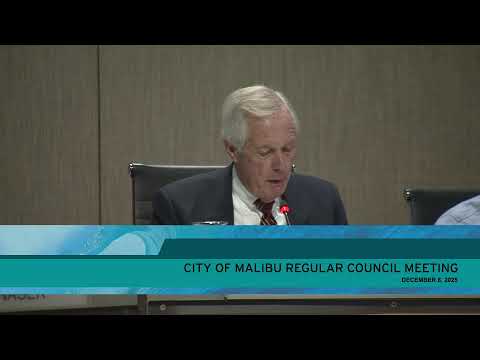
The Malibu City Council on Dec. 8 opened a broader policy discussion over how the city treats "beachfront" properties but stopped short of imposing new size limits on beachfront homes.
Planning staff explained the technical issue: the city has applied a decades-long precedent for which parcels qualify as "beachfront" for the purpose of applying beachfront development standards, but that definition is not codified in the Municipal Code or Local Coastal Program (LCP). Some council members and staff said clarifying the term would prevent misapplication of beachfront rules to bluff-top or rural-residential parcels that are not intended to receive beachfront allowances.
The public comment period grew lengthy and intense. Rebuild advocates, architects and many beachfront property owners warned that initiating a study or imposing new TDSF caps now would create market uncertainty, freeze lending and stall rebuilds for fire survivors. "If you introduce uncertainty around total square footage, loans freeze," one local architect told the council. Multiple commenters urged the council to avoid moving goalposts for people trying to rebuild after the fires.
Others urged the city to act to prevent the theoretical risk of an investor assembling many adjacent beachfront lots and constructing very large compound-style homes. Council members described that as the narrow problem they wanted staff to watch for, while also noting the need to avoid harming ordinary rebuilds.
After debate the council directed staff to initiate a limited LCP and Municipal Code amendment to codify the staff—s previously applied definition of "beachfront" (so that bluff-top or rural-residential parcels are not misclassified) and deleted language that would have directed immediate review or modification of beachfront TDSF rules. Council members stressed the instruction should not affect existing disaster-rebuild rights (like-for-like plus 10%) or short-circuit the city—s rebuild policy.
What comes next: Staff will prepare the LCP/Municipal Code amendment per council direction, circulate notice of availability consistent with the LIP and bring a draft back through the Planning Commission and the council; any LCP change will ultimately require Coastal Commission certification. Councilors suggested the clarification is not urgent but should be accomplished when staff bandwidth permits.
Quotes from the debate: "Nobody wants to limit the size of the houses you're trying to build right now," Council Member Steve Euring said, arguing the effort is intended to address very large, compound-style development rather than ordinary rebuilds. Architect and public commenters emphasized the risk to financing and the urgency of not creating uncertainty for homeowners in active rebuilds.
Provenance: Council directed the initiation of an LCP amendment to clarify the definition of "beachfront" and removed direction to modify beachfront TDSF standards (agenda item 7A).