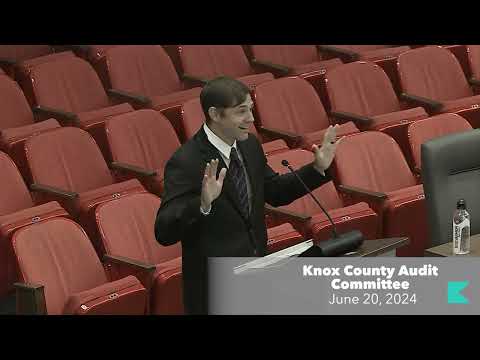
Finance director: revenues up but year-end surplus likely smaller; internal audit lays out FY25 plan, executive session set for Dynetics IT work
Loading...
Summary
Finance director Chris Caldwell said general fund revenues are up year-over-year but expenses grew faster, reducing the year-end surplus; internal audit presented a FY25 plan (fleet audits, schools payroll, space utilization) and the committee voted to enter an executive session to review confidential Dynetics IT findings.
At the June 20 meeting of the Knox County Audit Committee, Finance Director Chris Caldwell told the committee that general fund revenues through May were roughly $13.4 million higher than the same period last year, but rising expenses have narrowed the net surplus the county experienced a year earlier. "You will see that revenues are up about 13,400,000.0 over this time a year ago, but expenses are up about 21.8," Caldwell said, urging the committee to consider the net of those numbers as the fiscal year closes and noting that the county likely will not have as large an amount available for year-end designations as it did last year.
Chris Simons, representing Knox County Schools, said the school system remains in a solid financial position with expenditures on track and healthy fund balances, though he cautioned about a flattening sales-tax trend and said schools anticipated contributing to fund balance at year-end.
Zach Fullerton, county internal auditor, presented the FY25 audit plan and a summary of the office’s recent risk assessment. Fullerton said auditors met with roughly 24 of 96 stakeholders while preparing the plan and identified recurring concerns such as space constraints in the City-County Building (described as at or near 100% capacity), recruitment and retention pressures, and the recent, fast implementation of the schools’ compensation study. He outlined planned audits for FY25 including schools fleet management, sheriff’s office fleet management, a Knox County Schools payroll audit, petty cash reviews, a space-utilization review of the City-County Building, and non-audit services such as a property assessor attestation and grants time-tracking review.
Fullerton also noted ongoing confidential IT testing by Dynetics and requested that the committee move into a non-public executive session to review their findings. The committee voted to go into a non-public executive session under Tennessee Code Annotated 9-3-405 subdivisions (d)(1) and (d)(3) to discuss hotline matters and pending audits. A committee member moved the motion and it was seconded; the chair called for the vote and members answered "Aye" with no recorded opposition.
Fullerton closed by noting housekeeping items: staffing updates within the internal audit office, renewal plans for audit software HighBond, and that Internal Audit will continue to monitor open recommendations and retest where appropriate.
The committee approved the March 19 meeting minutes earlier in the session and adjourned after voting to enter the executive session; no additional formal policy actions or ordinances were adopted at the public meeting portion.