Get Full Government Meeting Transcripts, Videos, & Alerts Forever!
Get email alerts on the Wayfinding Kiosks topic
No spam. Unsubscribe anytime.
Burbank staff seek ordinance to allow 15-wayfinding kiosks; vendor proposed under no-cost, revenue-sharing model
Summary
City staff presented a proposal to install about 15 interactive wayfinding kiosks across Burbank, recommending direct negotiations with vendor Ike Smart City under a no-cost, revenue-sharing agreement; staff said an ordinance to amend the Burbank Municipal Code will be introduced for council consideration and return for a second reading Dec. 16, 2025.
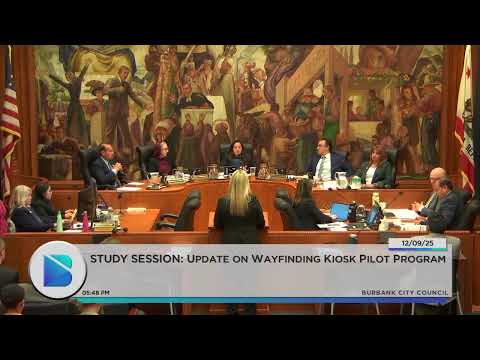
Courtney Padgett, assistant city manager, told the Burbank City Council and Housing Authority on Dec. 9 that staff is recommending a pilot wayfinding kiosk program that would start with about 15 kiosks in high-pedestrian areas and requires amendments to the Burbank Municipal Code to allow self‑illuminating electronic kiosks in the public right of way.
"This study session is intended to provide counsel with a high level overview of the program elements," Padgett said, outlining the program's goals: public information and emergency alerts, pedestrian wayfinding, support for local businesses, and reserved screen time for city messaging and nonprofit partners.
Padgett said the proposed agreement would be "no cost" to the city and structured as a revenue-sharing deal in which the vendor covers installation, operation and maintenance while providing a percentage of advertising revenue and dedicated screen time for city content. "So this is considered a no cost, revenue sharing agreement," she said.
Staff recommended proceeding via direct negotiations with a vendor rather than issuing a new RFP or relying on a piggyback contract, arguing direct talks allow the city to tailor performance requirements, public-safety measures, revenue splits and maintenance obligations. Padgett recommended Ike Smart City based on the firm's national experience and turnkey platform.
The presentation said proposed municipal code changes would create a new article in the streets chapter defining wayfinding kiosks, setting design and operational standards (including lighting and audio limits), and exempting kiosks from certain generic sign prohibitions while aligning encroachment-permit requirements.
Padgett described technical and operational safeguards staff expects to negotiate into any agreement: accessibility features (staff stated "100% ADA compliance"), integration with the federal Integrated Public Alert and Warning System (iPAWS) for emergency messaging, privacy commitments that user content would not be sold, and a proactive maintenance model.
Clay Colette, a representative of Ike Smart City, described the firm's field operations: "We send teams out 5 days a week, once on a weekend, assess them, make sure everything was good," and said most repairs can be handled on site with 24–48 hour turnaround for major fixes.
Council members asked questions about cost, vandalism, pedestrian and driver safety, ad content, and power. Councilor Anthony sought confirmation there would be no upfront cost to the city; Padgett repeated the no-cost, revenue-sharing structure and said specific revenue guarantees and terms would be finalized during contract negotiations. Councilor Mullins asked how nonprofits would be served; Padgett said a negotiated percentage of city screen time and unsold ad inventory could be allocated to nonprofit messaging at no charge.
City staff and the vendor addressed concerns about advertising format and road safety. Vendor representatives said kiosks have anti‑glare glass, ambient dimming sensors and software controls to prevent strobing or flashing content; they said kiosks do not use audio and that static ads are most common, though video can be supported by demand. The presentation also noted proposed advertising prohibitions for tobacco/vaping, firearms/ammunition, political advertising and lewd material.
On electrification, staff deferred to Burbank Water and Power. Riyadh Slayman (AGM, referenced in the presentation) said the units require little power, that contractors would build service in coordination with BWP, and that BWP would confirm and pull service to each kiosk location.
Padgett said the city will conduct community outreach if the program advances and that a demonstration kiosk is available in the City Hall rotunda for public review. The ordinance to amend the municipal code is expected to be introduced later the same evening and, if introduced, to return for second reading at the Dec. 16, 2025 council meeting; staff would then return to council with a negotiated agreement for approval.
No formal council vote on the ordinance or vendor agreement occurred during the study session; staff sought council feedback as it proceeds into negotiations.