
BMZA approves 52 townhomes at Reservoir Square parcel after lengthy public opposition; developer stresses grocery lease
Get AI-powered insights, summaries, and transcripts
Subscribe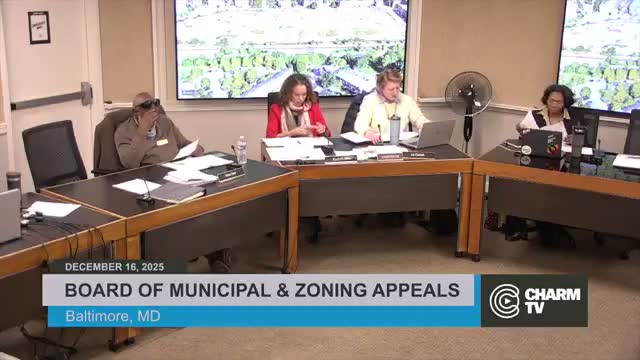
Summary
After extensive public comment alleging broken promises on retail and tree removal, the BMZA approved conditional use and front‑yard setback variances to allow 52 townhomes at Parcel C (700 W. North Ave) of the Reservoir Square redevelopment; developer and MCB Real Estate said the team secured a lease with Street's Market for grocery space at nearby 600 W. North Ave.
Baltimore — The Board of Municipal and Zoning Appeals on Dec. 16 approved a contested plan to build 52 townhomes on Parcel C (700 West North Avenue), part of the multi‑phase Reservoir Square redevelopment, granting conditional‑use approval and front‑yard setback variances after hours of testimony.
Drew Tilden, attorney for the applicant, and Theresa Stegman of MCB Real Estate described the history: an earlier plan for a multifamily building funded with new markets tax credits became infeasible after median income changes in the census tract removed eligibility for that funding. Tilden said the development team expanded the project area and determined that saleable townhomes were the financially viable way to complete redevelopment of a long‑vacant site.
"We signed a lease with Street's Market," Tilden told the board, describing a supermarket lease for the nearby 600 block that the development team said is central to delivering the grocery component residents have requested.
But neighborhood speakers urged the board to reject the variance and conditional use, alleging the project deviates from the Reservoir Square master plan and that trees were removed without adequate mitigation. "They can literally come into the city, and... promise everything, and deliver nothing," Lisa Ward, a Reservoir Hill resident, said. Other residents raised concerns about green space, tree loss and whether the developers’ outreach adequately represented neighborhood views.
Board members pressed the applicant about tree mitigation, green space, and the feasibility of alternative products (live‑work or lower‑density commercial). MCB representatives said the team has landscape plans approved by SPRC and committed to meet Baltimore City’s tree and landscape requirements and to hold securities for plantings.
After deliberation the board found the parcel’s slope and topography (a roughly 20‑foot grade change across the site) and prior community engagement and planning review supported project‑specific relief for front‑yard setbacks and that conditional‑use criteria were not met for denial under the Scholz v. Pritz standard. The BMZA voted to approve the conditional use and front‑yard setback variances. The board emphasized that the variance does not rezone the property and that future redevelopment or commercialization remains possible under existing zoning and through later approvals.
The board will draft and circulate a written resolution that will state findings and any conditions attached to the approvals.