Get Full Government Meeting Transcripts, Videos, & Alerts Forever!
Get email alerts on the Land Use Variance topic
No spam. Unsubscribe anytime.
BMZA approves Park Heights synagogue and community center, grants impervious‑surface variance
Summary
The Baltimore Board of Municipal and Zoning Appeals approved conditional‑use permits for a new place of worship and associated community center on Park Heights Avenue and granted a variance for maximum impervious surface after hearing planning and applicant testimony.
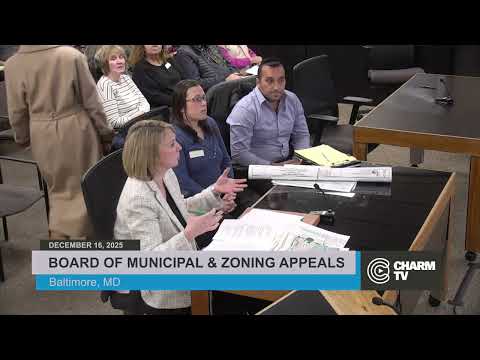
Baltimore — The Board of Municipal and Zoning Appeals on Dec. 16 approved a plan to convert a Park Heights Avenue property into a two‑story place of worship with an associated community center and granted a variance for maximum impervious surface. The action follows a revision to the application that resolved earlier parking and bicycle‑parking concerns.
Justin Walker of the Department of Planning told the board the package had been revised since an August hearing: off‑street parking was recalculated and now meets the required total, two long‑term bicycle parking spaces were added, and building height no longer exceeds the 35‑foot limit. "Planning recommends approval of those variances and the conditional uses," Walker said.
Applicant counsel explained the project was effectively two principal uses — a first‑floor synagogue with community‑center uses on the second floor and basement — and that combined fire‑rated capacities produce a parking requirement of 49 spaces, matching the revised plans. The team also proposed pervious modular sport tiles for an on‑site basketball court to reduce impervious coverage.
Board members concluded the site’s unusual zoning (an R‑1E parcel surrounded by R‑9 properties) created a practical difficulty tied to the impervious‑surface standard and that the project’s community uses would not unduly harm neighbors. After deliberation the board voted to approve both conditional uses and the impervious‑surface variance.
Justin Williams, the BMZA acting executive director, reminded appellants that board votes are followed by a written resolution: "By law, we must prepare a written document called a resolution, which requires drafting and review. Once the resolution is drafted, we will send it to you by email. If you're the appellant, you'll be able to access it through Acela."