Get Full Government Meeting Transcripts, Videos, & Alerts Forever!
Get email alerts on the Eec Finance Rollout topic
No spam. Unsubscribe anytime.
Massachusetts EEC details rollout of EEC Finance contracting system, timelines and provider responsibilities
Summary
The Department of Early Education and Care presented EEC Finance, an electronic contracting and reimbursement system, explained roles (minimum two UAAs per tax ID), training resources, and a rollout timeline contingent on the state MOSAIC accounting system; advance payments and reimbursement timing were described.
The Department of Early Education and Care (EEC) on a hosted webinar described EEC Finance, a new electronic contracting and reimbursement platform designed to replace paper-based workflows and reduce email attachments and administrative burden for providers.
David Manucci, director of procurement and grants at EEC, said the system centralizes contract documents, announcements and job aids and provides real-time visibility into contract totals, reimbursement requests and remaining balances. "This system reduces the administrative burden associated with external emails and email attachments and modernizes the contracting process," Manucci said.
Elyse Tibbets, identified in the session as the Priority Access Manager in the Family Access unit, told participants the system aims to limit duplicate work: approved FY26 contract documentation already submitted to EEC will not need to be resubmitted in EEC Finance. "You've already done that work," she said, and EEC will import approved documentation into the system rather than require providers to re-enter it.
EEC staff outlined how organizations must designate user access administrators (UAAs). EEC asks each provider to assign at least two UAAs per tax ID to ensure coverage if staff change roles or are on leave. UAAs set up internal roles tied to each contract—vendor contract manager, vendor fiscal representative and authorized signatories—and are responsible for updating and deactivating user access when personnel changes occur.
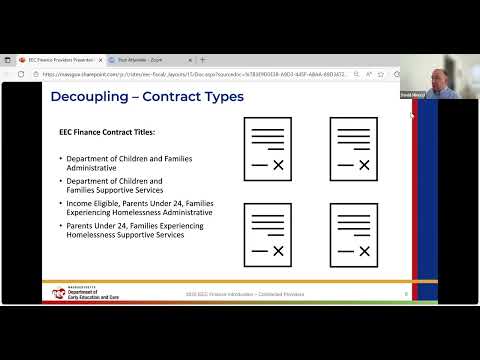
The agency described the contract types visible in the system (as labeled in EEC Finance) and provided counts during the session: 183 "5% admin" contracts and 123 supportive-services contracts were cited as examples of previously managed paperwork. The transcript reported a figure of "a total of $11.64" connected with attachments and files, but the session did not specify units for that dollar figure.
EEC presented a tentative rollout timeline and noted a dependency on the state comptroller's MOSAIC accounting system. Staff said EEC sent a welcome letter to providers on Nov. 10 asking for UAA information; EEC planned a soft launch to let providers check UAA designations and explore the platform before reimbursement workflows were enabled. During the webinar, presenters referenced a soft launch date of Dec. 8 and a support session on Dec. 12; they also discussed making the system available ("go live") in early January and asked providers to monitor Q&A updates for final dates.
Because EEC Finance must interface with MOSAIC, payment timing is contingent on that interface, EEC officials said. Manucci said EEC expects to advance payments in February 2026 for January and February services (contingent on MOSAIC connections) and that providers should expect to submit their first reimbursement requests through EEC Finance in April 2026 for March services. "We will notify providers directly when reimbursement request functionality is available in the system," he said.
For supportive-services contracts, providers will submit reimbursement requests by budget line via the expenditure details section. Job aids and three initial training modules will be posted under the EEC resources tab—site navigation, how to submit a reimbursement request, and how to create an amendment. Amendments will be required when a request exceeds the remaining balance for a budget line or when funds are moved between lines; each amendment will restart the submission workflow and include EEC and provider steps.
Staff demonstrated core navigation: the login page, left navigation (search, funding, inbox, agency document library, address book, EC resources), session timeout behavior, and page-specific help. They encouraged providers to use EEC Finance links rather than the browser back button to avoid navigation errors.
In the Q&A, providers asked whether UAAs can be designated per grant (Manucci: yes), whether announcements trigger automatic email notifications (EEC to confirm and add to the posted Q&A), and whether separate invoices would be required for providers with multiple funding streams (EEC to follow up). A participant asked about a prior 10% amendment threshold; presenters said that threshold will not apply in the new workflow and that small intra-line changes are expected to be routable without a programmatic conversation, though larger shifts may prompt further review.
EEC said slides and the session recording will be posted on the Childcare Financial Assistance hub and that a Q&A transcript will be published on the EEC resources tab. The session concluded with staff offering to gather answers to unanswered questions and post them in the resources tab.