
Santa Cruz supervisors move to tighten safety, require studies as county refines battery storage ordinance
Get AI-powered insights, summaries, and transcripts
Subscribe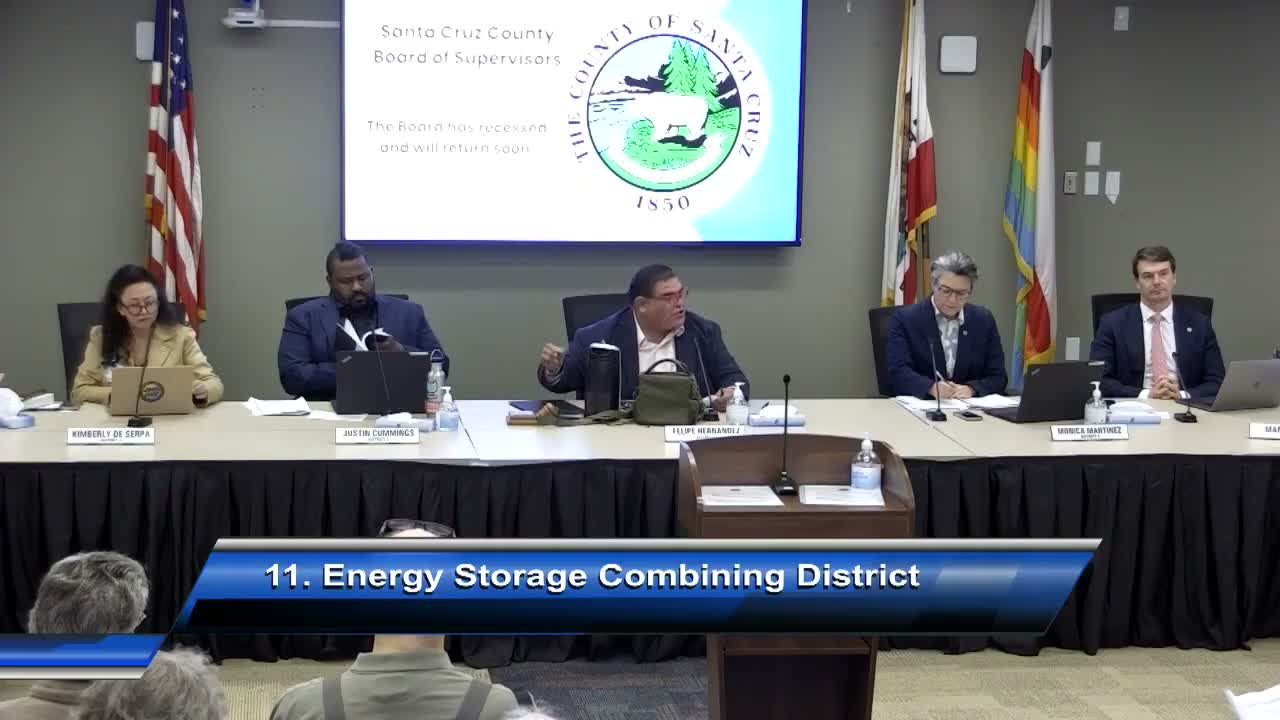
Summary
After hours of public comment and expert testimony, the Board of Supervisors directed staff to revise a draft battery energy storage (BES) combining-district ordinance to add measures on fire response, baseline air/soil/water monitoring and financial assurances, and to return with a new draft for the board’s review before CEQA and public hearings.
Terrence H. Hernandez, chair of the Santa Cruz County Board of Supervisors, on Nov. 18 directed county staff to revise a draft ordinance that would map a new battery energy storage (BES) combining district to parcels adjacent to transmission substations and to initiate environmental review with strengthened protections.
The board’s action follows a daylong public hearing in which scientists, firefighters, labor leaders, environmental groups and residents debated whether the county should adopt local rules or allow the state to decide siting and safety. Stephanie Henson, assistant planning director, said the draft ordinance would require large installations to meet National Fire Protection Association standards, the California building and fire codes, and new state safety laws enacted after the Moss Landing fire. Henson listed key elements the draft would require: containerized outdoor installations, a minimum 10-acre parcel size with a 20-acre maximum development area, “1000 foot setbacks” from sensitive receptors such as schools and residential-care facilities, continuous monitoring and alarms, air‑quality perimeter monitors and a decommissioning plan with financial assurances.
Why it matters: county officials said local rules preserve land-use control and let the county demand stronger safeguards than a state-only track; opponents argued that siting a large BES near agricultural land, wetlands or dense neighborhoods risks soil, water and food-supply impacts. The board asked staff to return with a revised draft that incorporates specific measures raised in public comment — including baseline and post‑incident air, soil and water monitoring; runoff and containment plans for firefighting water; explicit operational plans and battery‑disposal requirements; financial assurance and decommissioning bonds; and fire‑access and turnaround standards — and with options for recovering public‑service costs through fees or bonds.
County staff and supporters framed the ordinance as updated and safety‑focused. “To ensure that the safety standards are implemented, we’ve added several reports that would need to be submitted along with any application,” Henson said, naming community risk assessments, smoke‑drift plume studies, monitoring plans and annual testing. Bruce McPherson, former county supervisor and a leader on regional community‑choice energy policy, urged the board to retain local land‑use authority, calling the draft “much stricter than state law.” New Leaf Energy’s representative John Swift said local benefits include reduced outage risk and improved distribution reliability; he told the board the proposed site could serve hundreds of thousands of customers during outages.
Board response and next steps: Supervisors debated timelines and tradeoffs between stricter rules and the risk a developer might pursue the state process. Supervisor Justin Cummings and several colleagues said local control was worth pursuing; Supervisor Dawn DeSerpa and others pushed for clearer protections for nearby agricultural land and College Lake runoff. Supervisor Cynthia Martinez, who made the motion that passed, asked staff to identify potential public‑service costs and options for recovering them from developers and to return with a revised draft for board review before sending the measure to commissions and CEQA. Staff estimated roughly a three‑month turnaround to present an updated draft for the board’s input prior to formal environmental review.
The board voted unanimously to direct staff to prepare the revised ordinance, begin targeted environmental work, and return with the updated draft for board review and further direction.