
Debate flares over cannabis license revocation language after DUI‑related amendment proposed
Summary
After the board asked staff to draft language allowing license discipline when a patron later causes a DUI‑related injury, business owners, patients and advocates warned the measure could punish compliant operators and lacks reliable on‑site impairment tests; supervisors asked for revisions referencing existing 'refuse service to intoxicated patrons' models.
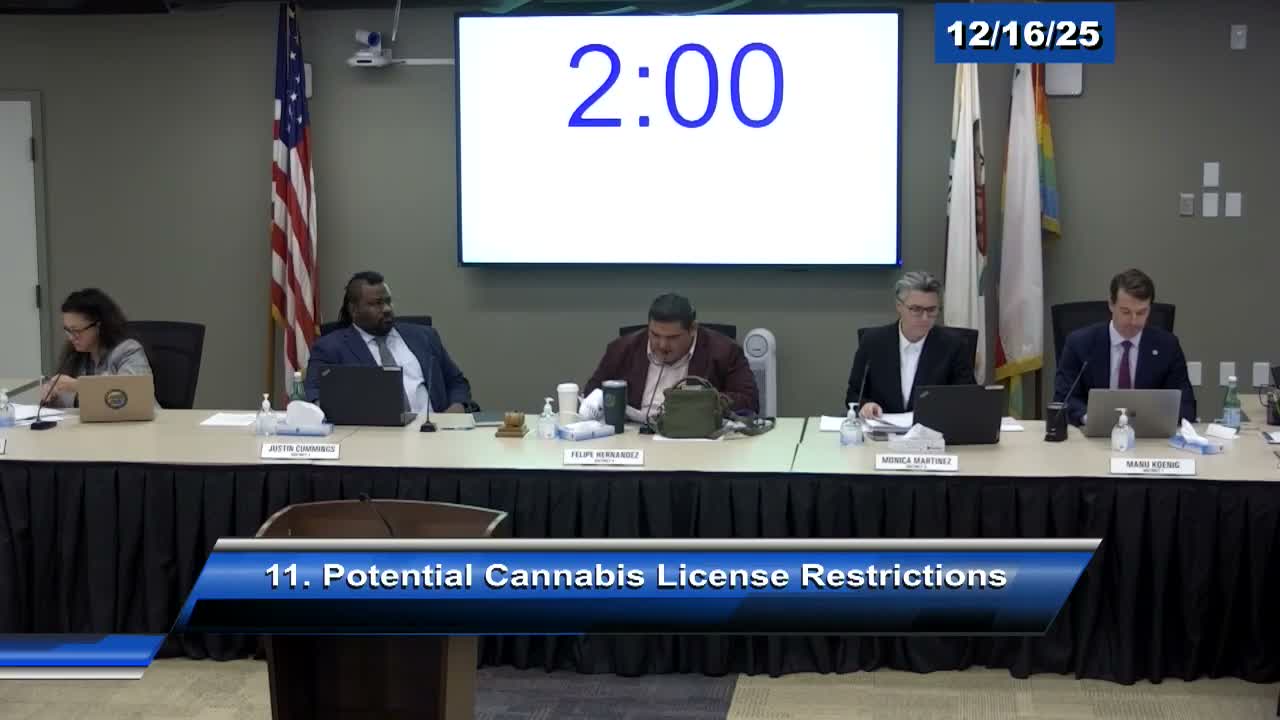
A controversial amendment to Santa Cruz County’s cannabis licensing code — drafted at the board’s prior direction to allow license suspension or revocation if a patron who consumed cannabis on site is later found guilty of a DUI causing injury or damage — prompted extended public comment and debate on Tuesday.
Staff presented ordinance language modeled on the board’s instructions. Industry representatives and medical cannabis advocates told the board the proposed broad outcome‑based trigger — where an off‑site driving conviction could lead to revocation of an operator’s license — lacks an ABC‑style on‑site overservice standard, does not require proof of on‑site consumption, and risks disparate treatment compared with alcohol establishments. They argued producers and retailers could be held liable for conduct they cannot control and that current forensic and roadside testing cannot reliably establish recent impairment by cannabis in many cases.
Several speakers urged the board to adopt operating standards similar to San Francisco’s approach (refuse service to intoxicated patrons; define intoxication; allow but not require employees to enter smoking rooms) and to focus on on‑site controls, training, transport options and enforcement of existing on‑site violations rather than tying revocation to subsequent criminal verdicts.
Supervisors debated options. Supervisor Koenig moved to replace the proposed revocation clause with a standard requiring permittees to refuse service to intoxicated patrons and to allow employees voluntarily (but not by contract) to enter designated consumption spaces; the board approved that approach and added suspension language and a split between lounge and retail authorizations so sanctions against a lounge would not automatically shutter a retailer’s broader license. The revised approach points staff to craft rules modeled on peer jurisdictions and San Francisco’s operating standards before returning for a formal reading.
What happens next: Staff will return with ordinance language that focuses on on‑site operating standards, intoxication definitions, training and enforcement mechanics; the board did not adopt a blanket outcome‑based revocation standard as drafted.

Create a free account
Unlock AI insights & topic search