Get Full Government Meeting Transcripts, Videos, & Alerts Forever!
Get email alerts on the Family And Community Supports topic
No spam. Unsubscribe anytime.
EEC spotlights CFCE network: 80 grantees, 25,000 playgroups and a statewide rebrand planned
Summary
Department leaders presented Coordinated Family and Community Engagement (CFCE) program data showing more than 25,000 playgroups and roughly $11.5 million in grantee funding in FY25, described partnerships (Parent Child Plus, Children's Trust, Boston Children's Museum, Reach Out and Read) and outlined a vendor-led rebrand to improve public recognition and referrals.
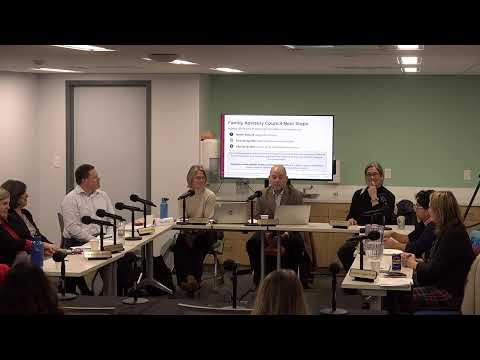
Department officials used the board's December meeting in Lynn to describe the scope and aims of the Coordinated Family and Community Engagement network (CFCE), the state'funded family and community supports that serve as many families'first contact with early childhood services.
Hajai Shearer, associate commissioner for family and community supports, told the board that CFCE includes 80 grantees serving all 351 Massachusetts municipalities and that grants range from about $37,000 to nearly $937,000. She said the department's FY25 reporting showed "almost 25,000" unique playgroups statewide and approximately 380,000 touchpoints (counting each instance a family accessed services). Hajai said CFCEs provided roughly 72,000 referrals and about 6,000 Ages and Stages (ASQ) developmental screenings in FY25. The department cited a total investment to CFCE grantees of just over $11,500,000, plus earmarks for Reach Out and Read ($1,750,000) and $4,250,000 for Parent Child Plus funding.
Speakers emphasized that CFCE services are no-cost and non-eligibility-based, delivered in libraries, community centers, family resource centers and other trusted local sites to create low-barrier pathways into early education and community supports. "Family and community support is where learning and connection really begin," Hajai told the board.
Panelists from local CFCEs illustrated how services vary by place: Kathy Turozian, Lynn Public Schools CFC coordinator, described multilingual playgroups and a permanent "story walk" at Flax Pond as local literacy investments; Cindy Horgan, Cape Cod Children's Place, highlighted place-based challenges such as limited winter transportation and seasonal housing patterns but said strong local partnerships produced consistent handoffs across communities; Kelly Ford, Central Massachusetts, described playgroups as a point for parents to observe child development and seek further screening when concerns arise.
Department staff also described a vendor-led rebranding effort to unify CFCE identity across 80 grantees, with a landscape analysis in progress and a public rollout planned in 2026. Board members and staff underscored that rebranding is intended to make services easier to find and to create a consistent, statewide front door for families.
Officials noted a close partnership with other state programs and organizations, including the Children's Trust (a Commonwealth public'private agency), Boston Children's Museum (training and materials), Reach Out and Read (pediatric literacy model), and DCF family resource centers. Several speakers said the Children's Trust will shift some direct CFCE funding to technical assistance that can scale across more sites.
Staff cautioned that CFCE counts "touchpoints" rather than unique individuals because programs intentionally avoid collecting identifying family data to lower access barriers. That design choice limits the ability to report unique-family counts but aims to maximize reach and low-barrier engagement.