Get Full Government Meeting Transcripts, Videos, & Alerts Forever!
Get email alerts on the Pavement Preservation topic
No spam. Unsubscribe anytime.
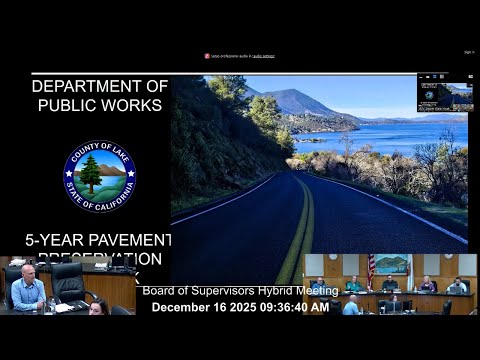
Lake County unveils realistic five‑year pavement preservation plan, supervisors press for clearer district rotation
Summary
Interim Public Works Director Lars Ewing presented a five‑year, financially constrained pavement preservation plan that targets about 155 miles of chip seal work over 2026–2030, funded mainly by SB1 and the Highway User Tax Account; supervisors asked for clearer district rotation and staff to explore local sales‑tax options.
Lake County Interim Public Works Director Lars Ewing on Wednesday presented a five‑year pavement preservation work plan that would target roughly 155 miles of chip seal over 2026–2030 and relies on recurring state and federal funding to sustain an expanded in‑house program.
Ewing described the proposal as "a realistic and financially viable plan," saying Public Works had returned to the "drawing board" to identify what the county’s road crew could reliably deliver. He told the board the county’s road network totals about 612 miles, of which roughly 464 are paved and 148 unpaved, and that a formal 2022 assessment by the Lake Area Planning Council put the countywide Pavement Condition Index (PCI) at about 34, in the poor range.
The plan centers on using county crews — a 28‑member road crew operating from three yards — to do the bulk of pavement preservation work, supplemented where necessary by contractors for specialized tasks such as oil application. Ewing said the department produced about 38.5 miles of chip seal in 2025 at material and contract costs of roughly $1.6 million, about $42,000 per mile in materials and contract expenses (staff costs are embedded in other budget units).
Under the proposed five‑year approach the county would average slightly more than 30 miles per year; Ewing used a planning assumption of $50,000 per mile (incorporating an estimated 6 percent annual escalation) to arrive at an average annual preservation cost of about $1.5 million and a five‑year total of under $8 million.
Ewing projected that the focused preservation work would raise the condition of treated roads to the "good" range and lift the countywide PCI from roughly 35 to about 48 over five years, assuming a 3‑point per year degradation on untreated roads. He contrasted the new plan with earlier, more costly proposals — a 2022 five‑year map that estimated $84 million and a 2023 ten‑year proposal estimated at about $102 million — calling those earlier maps "hopes and dreams" while emphasizing that his work plan was intended to be deliverable with available staff and typical revenue levels.
Supervisors questioned how the program would be distributed across supervisorial districts. Supervisor Owen said he was concerned two years of money had gone to what he described as "Jessica's district" and pressed for earlier attention to Middletown and District 1, asking whether the program rotates by district. Jim Hale, the county road superintendent, replied that the crew performed about 22 miles in District 1 the previous year and described the recent rotation and joint projects as responses to preparatory work and logistics. Ewing said the approach was based on a network perspective and road crews' local knowledge rather than a rigid district formula: "the road superintendent has responsibility for all roads."
Supervisor Sabatier praised the department’s results and urged the board to consider longer‑term funding options, including revisiting a local sales tax or self‑help measure to increase revenues and leverage additional state programs. Ewing said staff would research the revenue mechanics and polling if the board directed it, while noting that converting an idea to a ballot measure requires staff time for polling and planning.
Public comment included a statement from resident Wes Baker, who thanked the county crew for recent work on Winchester and praised the crew’s efficiency and courtesy, endorsing in‑house production rather than hiring larger contractors.
The presentation did not include a formal vote. Board members asked staff to provide clearer annual bid/project lists earlier in the year for governance planning and to report back on funding options if the board requests further study. The board closed the presentation portion of the agenda and moved on to other business.