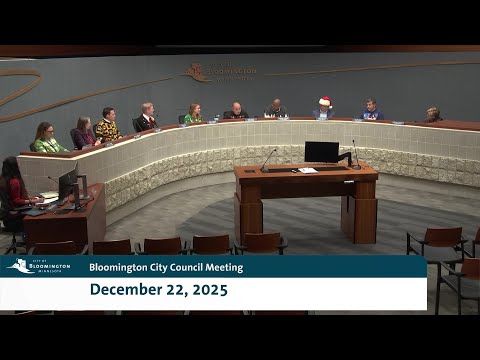
Bloomington council adopts Ferry Road corridor vision, favoring two‑way bikeway and interim safety fixes
Loading...
Summary
The Bloomington City Council on Dec. 22 adopted a corridor vision for Bloomington Ferry Road that endorses a two‑way bikeway with sidewalk on one side (preferred concept C), asks staff to preserve existing infrastructure where possible and directs two interim safety improvements; the vote was unanimous (7-0).
The Bloomington City Council on Monday adopted the Bloomington Ferry Road Corridor Vision Study, endorsing a long‑term cross section that includes a two‑way bikeway with a sidewalk on one side and interim safety improvements aimed at reducing speeds and improving pedestrian crossings.
Phil Kulis of SRF, the consulting team lead, told the council the technical advisory committee recommended “the two‑way bikeway with the sidewalk on the one side” after public engagement and an evaluation matrix. Kulis said the corridor will need full reconstruction within 20 years; staff estimated a baseline reconstruction cost of about $21,000,000 and said implementing the multimodal alternatives would add roughly $3–6 million depending on the final design.
The study drew public input in September (an open house with about 120–130 attendees and online comments). Kulis said the preferred concept scored highest on multimodal comfort and safety in staff and technical reviews; it also offers opportunities for stormwater management and greener medians. Council members and staff emphasized that interim striping and intersection adjustments — not wholesale reconstruction — could address immediate safety concerns at lower cost while design and funding proceed.
Council member Nelson, who had received many resident comments opposed to change, noted there are distinct conditions along the corridor and urged the council to preserve sections that currently work well while addressing documented safety problems. Nelson said he is “appreciative that staff was very clear that major improvements are going to be made when the road needs reconstruction,” and he flagged past crashes and a pedestrian fatality near Countryside Park as reasons to pursue short‑term safety fixes.
A motion from Council member D’Alessandro to adopt the study — including the preferred concept C and two interim safety improvements (corridor striping, intersection control modifications and crosswalk enhancements) — passed unanimously.
Next steps: staff will pursue funding opportunities, refine design to preserve existing curb lines where feasible, and bring project‑level designs and funding recommendations back to the council as the corridor moves into the design and implementation phases.