
Cartwright forum hears mixed views as district gathers feedback on returning to five-day week
Get AI-powered insights, summaries, and transcripts
Subscribe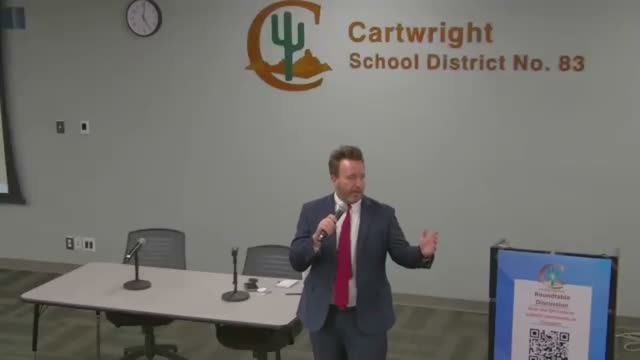
Summary
At a Cartwright Elementary District community forum, district staff outlined three options — keep four days, move to five days, or a hybrid with teacher work on Fridays — and invited comment. Teachers and support staff raised concerns about data consistency, teacher retention, special-education services, and costs; no decision was made.
Cartwright Elementary District officials convened a community forum to gather input on whether to change the district’s calendar from a four-day week back to a five-day schedule. District staff presented three options — remain on a four-day week, switch to a conventional five-day schedule, or adopt a hybrid in which teachers work more days while students attend four days and receive targeted Friday services — and repeatedly told attendees that "a decision has not been made."
The meeting featured extended public comment from teachers, instructional-support staff and other employees who urged careful review of the data and raised practical concerns about implementation. Ramon Lopez, an eighth-grade math teacher at CW Harris, said school-level data show improvements since the district adopted a four-day schedule: "During the 2021–22 school year, we had almost a 35 percent of our students who were chronically [absent]," Lopez said, noting that the rate fell to about 30 percent and later to roughly 24 percent in 2023–24. He argued those attendance gains and improvements in school letter grades counseled against an immediate return to five days.
Other staff raised questions about transparency and sample size in prior outreach. An instructional support specialist from Justine Spatami said parent-advisor representation appeared limited and that not all parents received surveys, urging the district to use multiple outreach channels beyond ParentSquare and ParentVUE to reach families. "If you really want to reach the community, you need to contact and reach out and talk to the community," the speaker said.
Teachers described the four-day week’s benefits for work-life balance and medical appointments and flagged operational risks if the district moves to five days. Lauren Richards, a teacher at Esri Middle School, said Fridays provide time for appointments and family; she warned that forcing more teacher days could increase demand for substitute coverage and strain counselors and RTI staff. Several speakers urged the district to consider alternatives — smaller class sizes or more in-class support — rather than treating five days as the sole improvement lever.
Special-education staff and therapists reported logistical challenges that could follow a districtwide five-day calendar. Rachel, an occupational therapist, said many families schedule therapy on Fridays and that changes could increase truancy or require contracting external therapists. She estimated the annual cost of a contracted therapist could be on the order of six figures and urged the district to quantify those costs.
District staff described the hybrid model as one option that would keep students on a four-day schedule while using Friday for targeted instruction and professional development, and said compensation would be provided for staff who work on Fridays. Several speakers proposed a narrower alternative: keep the district on a four-day week but open selected campuses on Fridays to provide enrichment and preserve ESP roles.
Officials framed the session as one step in a short public process. The presenter said staff will continue to collect input through surveys and QR-code links, present information to the governing board in December (with no vote expected that month), and return in January with options the board may choose. "We are here to collect feedback," the presenter said. "A decision has not been made."
Next steps: the district will collect additional feedback online and in future community meetings, and district leaders plan to present options to the governing board in December and January. No formal action or vote occurred at the forum.