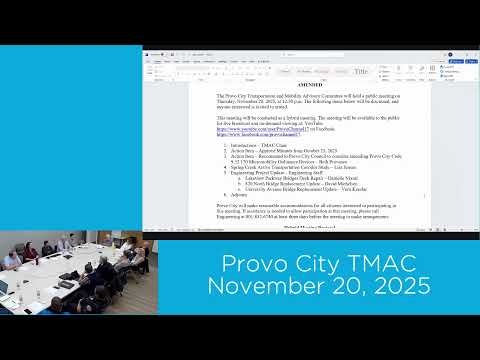
TMAC hears UDOT‑backed feasibility plan to link Provo train station to Springville; MAG grant funds study
Loading...
Summary
TMAC members reviewed a feasibility study for a UDOT‑supported trail connecting the Provo train station to Springville. Speakers said the route avoids sensitive properties, aims for a 12‑foot paved multiuse path, and benefited from a $150,000 MAG grant for the study.
Provo’s TMAC on Nov. 20 received an update on a feasibility study for a regional trail intended to connect the Provo train station east on 600 South through a route that avoids sensitive properties and seeks safe crossings toward State Street and Springville.
Lisa Jensen, representing the steering committee, described the proposed routing and said the preferred line would use the east side multiuse path to reach Lakeview Parkway and then connect through an industrial‑park area near the Provo‑Springville border. Speakers emphasized partnering with the private developer Clyde Properties on a mixed residential/retail segment to reduce frontage crossings of State Street.
Vern Keesler said the study is roughly one‑third complete and the steering committee prioritized avoiding constrained areas, such as a fish hatchery and railroad right‑of‑way setbacks, that limit rail‑trail or cut‑through options. "We went out and got $150,000 from MAG to do the study," Keesler said, describing consultant and MAG coordination. Committee members noted that Utah Trail Network interest and potential state funding could support the project but that specific construction funds were not yet committed.
Speakers said the design envisions a 12‑foot paved multiuse path separated from traffic in most segments; some sections might use protected on‑road facilities where right‑of‑way limits require it. Next steps include steering‑committee work in February and adoption of the feasibility recommendations into Provo and MAG plans before design and construction can proceed.
Timeline: steering committee meets in February; the feasibility study is expected to be finalized late spring or early summer and would then need formal adoption into city and regional plans.