Get Full Government Meeting Transcripts, Videos, & Alerts Forever!
Get email alerts on the Micro Mobility topic
No spam. Unsubscribe anytime.
TMAC recommends city council review micro‑mobility code updates, adds education to proposal
Summary
Provo’s Transportation, Mobility and Active Committee voted to forward a recommendation to City Council urging review of micro‑mobility rules focused on safety/age limits, riding location/speed and equipment/traffic adherence, with an added emphasis on public education.
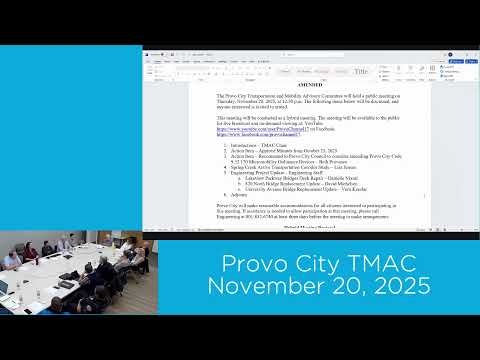
Provo’s Transportation, Mobility and Active Committee voted Nov. 20 to send a recommendation to the City Council asking staff to analyze potential updates to the city’s micro‑mobility code and to pair any code changes with public education.
The motion, offered by TMAC member Greg McFarland, sought to package three areas for council review: safety and age requirements; guidance on riding locations and speed (for example sidewalks, bike lanes or shoulders); and traffic‑adherence and equipment standards. "I move that we accept this as written with an addition to communicate a desire to communicate," McFarland said. David Day seconded the motion, which passed on a voice vote.
Committee members asked that city policy analysts prepare a concise staff report that reviews what other Utah cities have done and that summarizes TMAC’s pros and cons so council staff do not have to review an extended record. Chair Beth Provence and others recommended attaching condensed meeting notes and the documents presented to TMAC so the analysts can capture the range of views without replaying a year of meetings.
Members also discussed enforcement, saying penalties and police discretion would need to be considered if code changes create new infractions. Vern Keesler noted that officers should retain flexibility to respond to context (for example, different treatment for a young teen versus an adult). TMAC agreed to include communication and education in the package while recognizing that administration would handle much of outreach if the council pursues code changes.
Next steps: TMAC will forward the motion and supporting materials to the City Council; council policy analysts are expected to research statewide approaches and return recommendations that the council may then refine into ordinance language or administrative programs.