
Kent County funds DV network, launches high-risk team and specialized court program
Get AI-powered insights, summaries, and transcripts
Subscribe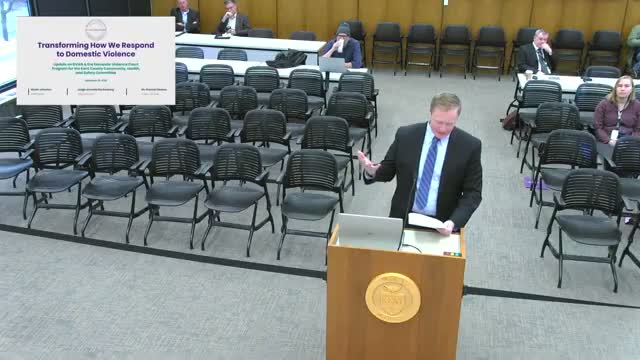
Summary
The Kent County Domestic Violence Action Network outlined a coordinated response—including a new high-risk team piloted in Grand Rapids, a 52-week batterer intervention program, mobile advocacy and a domestic violence treatment court—backed by a $4 million county ARPA grant intended to expand services and reduce repeat offenses.
Micah Johnston, director of the Domestic Violence Action Network (DVAN), told the Community Health and Safety Committee that the county has invested in a coordinated response to domestic violence that combines law enforcement, victim advocacy and court-based treatment. "We are now a network of 60 organizations and 300 individuals working together," Johnston said, describing the network's goal to reduce gaps that put victims at risk.
Johnston said the county agreed in 2022 to fund $4,000,000 to formalize earlier efforts into DVAN and to launch key initiatives: three mobile advocates funded through partnerships with Puertas Abiertas and Safe Haven Ministries; a domestic violence High Risk Team (HRT) piloted in Grand Rapids on Dec. 1; and a domestic violence treatment court that began accepting cases in July 2024. "The high risk team model follows a national gold standard for domestic violence homicide prevention," Johnston said, adding that HRT partners deploy an evidence-based danger-assessment tool on every call to identify those at highest risk.
Judge Amanda Turkenberg, who leads the county's specialty domestic-violence court, described the court's problem-solving model and the role of judicial oversight in supporting behavior change. She said participants enter a structured program that includes holistic case management, regular judicial reviews and a 52-week certified batterer intervention program (BIP). "When they work the program, the facilitators are rooting for them," Turkenberg said, stressing that long-term behavior change requires intensive, sustained support.
Ramiel Stephenson, a participant in the DV CORP program, described personal progress: "The program has definitely given me the tools to turn my life around," he said, recounting sobriety, regular check-ins and court participation that he credited with improving his relationships and employment.
Commissioners asked about the duration and sustainability of ARPA funding and program eligibility. Johnston said the ARPA grant was originally structured as a four-year award with a current end date in December 2026 and that DVAN was pursuing a no-cost extension and diversified funding sources. Turkenberg said individuals must be charged with qualifying intimate-partner-violence offenses to participate in the domestic-violence court; certain exclusions apply (for example, significant unmanaged mental-health concerns), and transfers among district courts are possible under the jurisdictional-transfer statute.
Johnston presented county-level figures to illustrate demand: law enforcement agencies respond to roughly 2,500 domestic-violence incidents annually, and one agency reported 3,000 crisis contacts between January and September with more than 2,300 unique individuals. He also cited research-based estimates (from the Geiger Institute) that roughly 30% of law-enforcement domestic-violence calls are high-risk—an extrapolation that would translate to about 750 high-risk calls per year in Kent County.
The committee applauded the collaborative model and recommended continued pursuit of sustainable funding. No formal action was taken on program design at this meeting; commissioners received the presentation and posed questions about next steps. The item concluded with Chair Hildenbrand thanking presenters and recognizing the need for ongoing community and agency collaboration.