Get Full Government Meeting Transcripts, Videos, & Alerts Forever!
Get email alerts on the Animal Welfare topic
No spam. Unsubscribe anytime.
DeSantis pushes breeder licensing, hotline and tougher penalties at Big Dog Ranch Rescue event
Summary
At Big Dog Ranch Rescue in Dade City, Gov. Ron DeSantis and state officials announced plans to pursue legislation that would license dog breeders, create a hotline to report abusive breeders, require pet-store adoption space, and increase penalties for animal abuse; agency leaders said implementation would involve Agriculture and DBPR oversight.
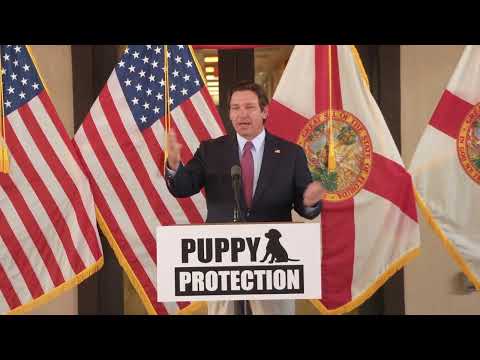
Governor Ron DeSantis onstage at Big Dog Ranch Rescue in Dade City announced the administration’s plan to pursue new legislation next session to regulate dog breeders more strictly, create a hotline for reporting abusive operations and tighten penalties for animal cruelty.
DeSantis said the proposals will include licensing for breeders administered by the Florida Department of Business and Professional Regulation, best-practice standards developed with the Department of Agriculture, a consumer-protection component to clamp down on predatory pet-financing and a requirement that pet stores offer space to local shelters before selling breeder-sourced dogs. “We will establish a hotline for individuals to call and report animal abuse by breeders to better crack down on bad actors,” he said.
The proposals come alongside references to laws DeSantis said his administration has already signed. He cited what he referenced as “Senate Bill 388,” a measure to authorize emergency-service vehicles to transport injured police canines to veterinary clinics, and said earlier actions increased criminal penalties for knowingly causing great bodily harm to police and service animals (he referenced “Senate Bill 96” and “HB 1047”). He also cited recently signed measures he named “Trooper’s Law” and “Dexter’s Law” as examples of prior steps to protect animals.
Commissioner of Agriculture Wilton Simpson said the Department of Agriculture will apply its experience with best management practices (BMPs) to develop science-based, enforceable standards for breeders and work with the Florida Board of Veterinary Medicine. “Today, we are here to create a transparent, consistent breeder registration system,” Simpson said, adding that the department has recently updated BMPs in other areas and will bring that expertise to animal-care standards.
Melanie Griffin, secretary of the Florida Department of Business and Professional Regulation, described DBPR’s potential licensing role. “Our goal is to create a fair level playing field supporting these good actors while holding bad actors accountable as they should be,” Griffin said, adding the department would aim to license efficiently and focus enforcement on abusive operators while avoiding unnecessary red tape for responsible breeders.
Lori Simmons, founder and CEO of Big Dog Ranch Rescue, described the conditions her organization sees daily—mothers bred repeatedly until they are disabled, puppies arriving severely ill and animals with traumatic injuries—and urged lawmakers to act. “This is not rare. This is not exaggerated,” Simmons said, describing dogs with hair loss from stress and animals injured by improper cleaning methods. She recognized sponsoring legislators in attendance, including Representative Meg Weinberger and Senator Ileana Garcia, and thanked the governor for his support.
On enforcement and penalties, DeSantis compared a breeder license to other state licenses with high value and consequences for violation: “If they…pull your license, well, then all of a sudden…you can’t operate,” he said, arguing that licensing creates a durable enforcement tool. He also said the administration will pursue stiffer penalties for abuse—particularly abuse in front of minors—and transparency measures for veterinary health statements and financing arrangements tied to pet purchases.
DeSantis encouraged legislators present to move the measures through the House and Senate next session and said the administration would reconvene at Big Dog Ranch for future bill signings if the proposals advance. No formal votes or bills were finalized at the event; officials described the day as an announcement of policy priorities and a call to legislative action.
What’s next: officials said they will work with the legislature and relevant boards to draft licensing requirements and best-practice standards; timing and specific statutory language will be determined by the legislature in the next session.