Get Full Government Meeting Transcripts, Videos, & Alerts Forever!
Get email alerts on the Budget Overview topic
No spam. Unsubscribe anytime.
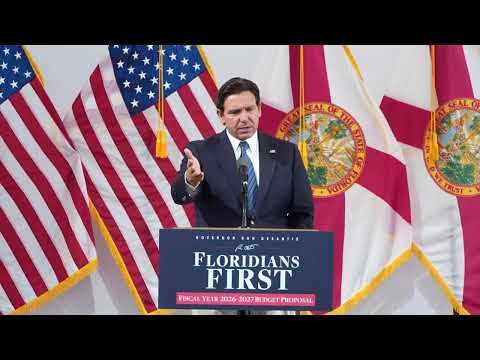
DeSantis unveils 'Floridians First' budget, cites record reserves and debt reductions
Summary
Governor DeSantis presented the administration's 'Floridians First' budget recommendation, saying reserves have grown to roughly $17 billion, the rainy-day fund is constitutionally 'maxed out,' and the administration has accelerated debt retirement while proposing continued investments across education, infrastructure and public safety.
Governor DeSantis onstage at the Doctor Phillips Center on Thursday presented the administration's proposed state budget — branded 'Floridians First' — and said the plan builds on record reserves and accelerated debt repayment.
"We more than tripled the state's rainy day fund," DeSantis said, adding that the fund is now "maxed out" under the Florida Constitution and that the administration has retired "more than half" of the state's outstanding debt "just since I've been governor." He said total reserves in the proposal are about $17,000,000,000 and the top-line budget is in the "$117,000,000,000" range.
The governor framed the budget as a mix of fiscal restraint and targeted investments: accelerating debt retirement to reduce interest costs while maintaining or modestly adjusting baseline spending. He compared Florida's spending and staffing per capita with larger-spending states, arguing Florida maintains lower state payrolls and competitive outcomes.
DeSantis also previewed a plan to place a property-tax-related measure on the November 2026 ballot focused on homesteaded residential taxpayers; he said the administration had included funding in the proposal to reimburse homestead reductions for fiscally constrained counties. "We're working on some good stuff," he said, adding the measure is intended to win broad support.
The governor repeatedly framed the budget as the product of conservative stewardship and legislative cooperation, saying he has used veto authority selectively to restrain line-item spending while preserving core priorities. He closed by thanking agency leaders and legislative allies and by urging continued fiscal discipline as the legislature considers the proposal.
The proposal is a recommendation from the governor's office; lawmakers will consider, amend and ultimately must adopt a budget through the legislative process. No formal adoption or vote occurred at the event.