Get Full Government Meeting Transcripts, Videos, & Alerts Forever!
Get email alerts on the Land Use Appeal topic
No spam. Unsubscribe anytime.
Planning Commission denies Waters family appeal over Peacock Court home, citing design and water‑system concerns
Summary
The Santa Clara County Planning Commission on Dec. 18, 2025 denied an appeal by the Waters Family Trust seeking design review and grading approval for a large residence and ADU on Peacock Court, upholding the zoning administrator’s prior denial after finding unresolved discretionary massing issues and outstanding water‑system compliance concerns; vote was 6–1.
The Santa Clara County Planning Commission voted 6–1 on Dec. 18 to deny an appeal from the Waters Family Trust and uphold a zoning administrator’s Nov. 5, 2021 denial of a concurrent design‑review and grading application for a single‑family home with an accessory dwelling unit at Peacock Court in unincorporated Cupertino.
Staff told the commission that although the project meets objective development standards for height and wall length, the discretionary findings for form and massing could not be made because the structure remains visually dominant and insufficiently stepped into the hillside. Environmental Health staff also concluded the existing Peacock Court Mutual Water Company will‑serve letter is not sufficient: the proposed project would cause the small water system’s service connections to exceed state thresholds, triggering a state referral and raising uncertainty about water‑system compliance prior to permit issuance.
The project before the commission includes a large single‑family residence and detached ADU, plus an attached 3,000‑square‑foot concrete deck, an indoor basketball court, pool and septic system; planning staff cited a 9,200‑square‑foot house and grading reductions from previous proposals. Planning staff recommended the commission deny the appeal. Alternative Attachment C materials included a CEQA exemption analysis and an amended set of conditions, including a condition (condition 42) drafted with Environmental Health addressing water verification if the commission were to approve the project.
During the hearing, the applicant’s counsel and many neighbors pushed back, saying the Waters family submitted a will‑serve letter and relied in good faith on prior approvals and that many concerns raised by staff were discretionary rather than objective code violations. Environmental Health witnesses responded that the will‑serve letter submitted in 2024 was reviewed and that when connections and estimated population exceed state thresholds, the state’s Division of Drinking Water may require a transition to a public water system — a process DEH said is technical and overseen by the state.
Commissioners pressed staff and the applicant about what materials were submitted after the Sept. 2024 hearing and when certain items (such as valley‑floor cross‑sections and coordination meetings) occurred; staff said the applicant provided some materials two days before the hearing (12/16/2025) and that limited coordination with DEH had occurred within the required 30‑day period following the prior hearing. Commissioners split on whether the outstanding water issue could be made a condition tied to building‑permit issuance; county counsel and DEH explained that water verification generally must be demonstrated before a building permit can be issued even where it is not a required design finding for this specific design‑review/grading appeal.
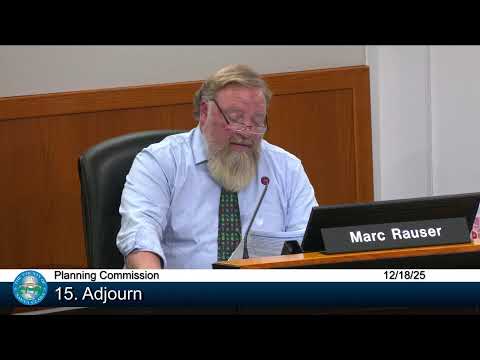
After deliberation, Commissioner Hederle moved to deny the appeal (seconded by Commissioner Escobar). The roll call vote was Hederle Aye, Cohen Yes, Belska Yes, Levy Aye, Escobar Yes, Vice Chair O'Donohue Yes, and Chair Rausser No, and the motion carried. Planning Commission staff reminded the public the decision is appealable to the Board of Supervisors within 15 calendar days.
The ruling leaves the Waters family the option to submit a modified application that addresses the commission’s discretionary findings or to pursue the separate enforcement and compliance channels that DEH and the state manage for small water systems. The commission’s staff report, Attachment C and the DEH memo are posted with the project record for PLN20‑124‑APL2.
The project remains subject to normal building‑permit requirements, and staff noted that if the project is approved in a different proceeding, DEH’s requirements for water proofing/clearance and any necessary state actions would have to be satisfied before permits are issued.