Get Full Government Meeting Transcripts, Videos, & Alerts Forever!
Get email alerts on the Environment Land Use topic
No spam. Unsubscribe anytime.
Council committee advances Bill 26-25 on vegetation and invasive bamboo amid operational concerns
Summary
The Transportation and Environment Committee advanced amendments to Bill 26-25, which would exempt native plants, redefine "weeds" as vegetation, and prohibit planting/transplanting of invasive (running) bamboo while agencies warned of enforcement and remediation burdens.
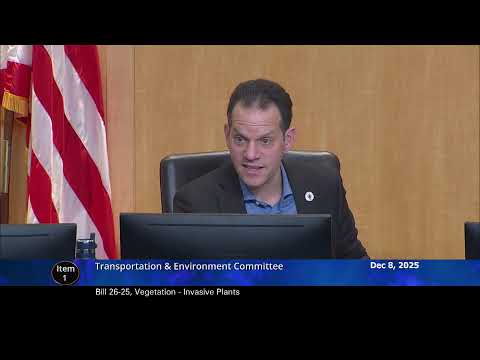
The Montgomery County Transportation and Environment Committee on Dec. 8 debated and advanced amendments to Bill 26-25, a measure that would change the county's Chapter 58 (weeds) to better accommodate native plants and restrict invasive bamboo.
Chair Glass, the bill sponsor, said the ordinance would redefine the term "weed" to exempt native plants and grasses and prohibit the sale and transplanting of invasive bamboo. He cited Delegate Linda Foley’s 2024 legislation in Annapolis that allowed local jurisdictions to regulate invasive bamboo sales and noted the bill aims to reduce neighbor-to-neighbor disputes and costly remediation.
County staff from the Department of Environmental Protection (DEP) and the Department of Housing and Community Affairs (DHCA) presented amendments and a PowerPoint explaining enforcement implications. DEP and DHCA indicated they support the bill’s intent but urged changes to make enforcement feasible: remove species-by-species lists in favor of vegetation-based standards; clarify applicability beyond platted subdivisions; and define operational thresholds (for example, allowing vegetation up to 12 inches high within certain setback areas unless regularly maintained).
Key amendments the committee accepted included: - Replace a local enumerated species list with a reference to the Maryland Department of Agriculture and the Maryland Invasive Species Council lists. - Add DHCA authority to require immediate corrective action when a director finds an imminent threat to public health or safety, but modify language so enforcement aligns with the notice deadline set in the abatement notice (resolving a potential contradiction with existing 10-day notice procedures). - Delete creation of a new appeals path to the Board of Appeals and instead rely on existing enforcement and appeals channels. - Clarify the biological definition of invasive (running) bamboo and exempt limited consumer uses such as indoor houseplants and cut bamboo stalks used for decoration or consumption.
DEP and DHCA warned of operational constraints: DHCA received more than 700 vegetation complaints in FY25 and county code inspectors do not have year-round botanical expertise to identify herbaceous plants. Staff argued a vegetation-focused standard (for example, the 12-inch rule near property lines and curbs) and clearer locations of applicability would produce fairer, more consistent enforcement than maintaining a locally curated species list.
Committee members pressed two primary concerns: (1) the burden on homeowners who cannot afford or physically perform remediation if the county intervenes, and (2) whether an immediate-abatement authority would be meaningful given existing notice and court-ordered abatement practices. DHCA said the county typically posts properties, gives a 10-day notice and then proceeds; certain emergencies might be addressed in 24–48 hours, but most abatement work follows existing timelines.
The most contentious debate concerned the proposed prohibition on the sale of invasive bamboo. The executive branch’s addendum offered alternatives — removing the sale ban but strengthening requirements for owners to manage existing bamboo patches — which some council members viewed as undermining the bill’s original intent. Staff noted that banning sale would require outreach to retailers and nurseries because running bamboos appear in some indoor plants and commercial landscaping uses; other neighboring jurisdictions already have similar prohibitions.
Several members urged that broader, more substantive changes (for example, adding new enforcement locations, changing chapter titles, or sweeping remediation rules) be handled in separate legislation with public input. The committee accepted a set of technical and operational amendments today and deferred other late addendum changes to staff review and possible consideration at full council.
Quotes that capture the discussion: "We're working to figure out how to ease concerns among certain communities, and also promote more pollinators..." — Chair Glass. "DHCA has received over 700 weed complaints in FY25 alone. It is not operationally feasible to enforce complaints about weeds if inspectors are identifying or creating appropriate native plant lists." — DHCA/DEP presentation.
Next steps: The committee approved the package of amendments discussed and will send the revised bill for further consideration; staff will review the late addendum proposals and the chair said some items may be brought to full council or handled in a follow-up bill with additional public hearings.