
Dublin City Schools outlines College Credit Plus rules, deadlines and family cautions
Get AI-powered insights, summaries, and transcripts
Subscribe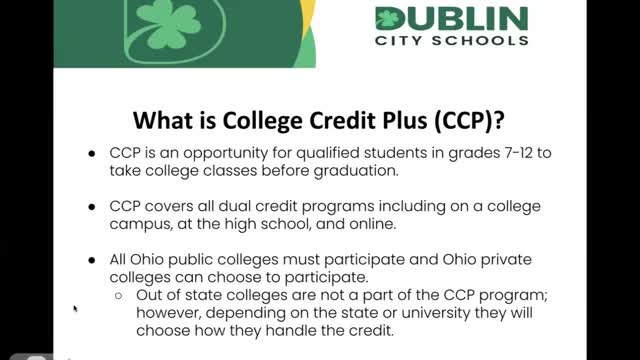
Summary
Counselors and college partners explained Ohio’s College Credit Plus program, eligibility and registration steps, the 30‑semester‑hour annual credit cap (summer counts), FERPA implications for parental access, and key deadlines including a Feb. 10 priority intent form and April 1 final deadline.
Kevin Patton, a counselor for Dublin City Schools, told families the district’s presentation walked through the College Credit Plus (CCP) dual‑enrollment program and the steps parents and students must follow to participate.
"College Credit Plus is our dual enrollment program offered through the state of Ohio," Patton said, explaining CCP lets students earn college and high‑school credit for the same class and is open to students in grades 7 through 12. He stressed that eligibility requires Ohio residency and college admission or placement: "there are certain requirements you have to meet, and it's gonna vary from school to school."
Why it matters: Patton said students can earn up to 30 college semester hours per academic year — and summer courses count toward that limit — which can reduce college costs but also create scheduling and academic risks if families enroll too early or without sufficient preparation. He explained how college semester hours convert to high‑school credits (generally 3 semester hours = 1 high‑school credit) and how those totals are subtracted from the district’s annual allowance.
Patton cautioned families about academic support and privacy differences at the college level. "If a student is enrolled in college, regardless of their age, they are the main person who will be reviewing grades, getting communicated with through teachers," he said, noting professors and college offices will typically communicate directly with the student under the Family Educational Rights and Privacy Act (FERPA). He urged parents to confirm accommodations remain in place by working directly with college disability offices when appropriate.
The district outlined several practical points for families: college admission standards will vary (some programs use GPA or placement tests), student‑athletes must meet local eligibility rules (Patton noted a 5‑credit requirement per quarter at the high‑school level), and transportation to off‑campus college sites is the family’s responsibility. Patton also warned that families may be required to reimburse the district for tuition or materials if a student fails or withdraws after the college’s refund/cancellation deadline.
Deadlines and next steps: Patton encouraged families to complete the CCP intent form as soon as possible. Dublin’s presentation listed a Feb. 10 priority deadline and an April 1 final deadline for the district’s timeline; completing the college applications and registration steps does not lock families into a program but keeps options open. He directed families to school counselors, the Dublin College Credit Plus site and Emerald Campus resources for step‑by‑step guides and contact information.
The district said the recording of the session and the presentation materials will be posted for families who could not attend and invited follow‑up questions via counselor appointments or the college advisers who joined the meeting.