Get Full Government Meeting Transcripts, Videos, & Alerts Forever!
Get email alerts on the School Finance topic
No spam. Unsubscribe anytime.
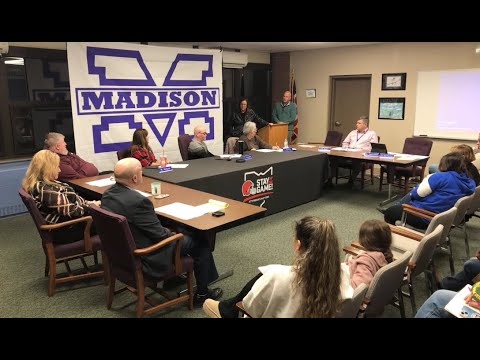
Madison Local board approves deficit-reduction plan after state flags three-year shortfalls
Summary
Madison Local Board of Education on Nov. 18 approved a written deficit-reduction plan after the Ohio Department of Education and Workforce flagged projected deficits in the district's October financial forecast and set a Dec. 21 deadline to submit a corrective plan to avoid fiscal oversight.
Madison Local Board of Education voted unanimously Nov. 18 to approve a written deficit-reduction plan after a review by the Ohio Department of Education and Workforce found projected deficits in each of the next three forecast years.
Christopher Wright, a fiscal consultant with the Department of Education and Workforce, told the board the department examined the district's Oct. 13 forecast and found negative balances on key forecast lines, which triggered a notification letter issued Oct. 22 and a requirement that the district produce a written plan by Dec. 21 to avoid escalation to fiscal oversight. "In this case, all 3 years are projecting deficits," Wright said during the presentation, noting the department flags districts for precaution when the first projected years show shortfalls.
The plan approved by the board is the current-year package the administration says will eliminate the immediate year 1 deficit. Wright and his colleagues emphasized that the department requires the written plan to rely on items the district can control, not on a new levy; the plan workbook and an accompanying narrative must be adopted by the local board and then reflected in the district's February forecast update.
Board and administration members outlined the sources of the change between earlier forecasts and the current one: declining enrollment, changes in the state's funding method, a decision by the county commissioners that doubled the homestead exemption and owner-occupancy credit (estimated in discussion to reduce district revenues by about $400,000 annually), and a higher-than-expected health-insurance assessment (discussed as roughly $430,000). The board president said those two items together were responsible for "around $800,000" of unanticipated cost pressure.
Members asked about extensions and the effect of incoming board membership. Wright said extensions can be requested for good cause but that the current board retains local authority until new members are sworn; he cautioned that failing to submit and adopt a required written plan within the prescribed timeline can lead to escalation into fiscal oversight, with monthly reporting and tighter state review.
Several departmental recommendations accompanying the plan focused on eliminating deficit spending: pause hiring and use attrition, right-size class and program offerings, consider retirement incentives where appropriate, create a finance committee, and increase fiscal transparency with monthly budget-to-actual reporting tied to the plan. Wright said the department would work with district staff to update forecasts to reflect adopted plan items and monitor implementation.
The board approved the plan on a 4-0 roll-call vote; the minutes and roll call listed Mr. Douglas, Miss Hayes, Mrs. Sensing/Simpson and Mr. Thompson as voting "Yes." The district will submit the adopted written plan to the Department of Education and Workforce to meet the Dec. 21 requirement and must reflect those plan items in the February forecast update.
The board also approved a series of personnel and consent items during the meeting; none of those votes changed the outcome of the written plan approval. The board announced it would continue community engagement and hold an additional public meeting at the library the following day to discuss the reductions and collect community input.
What happens next: the district must submit the written plan by the Dec. 21 deadline or request an extension with documented cause. If the district does not meet the requirement, the Department has procedures that can escalate a district into fiscal caution, watch or emergency — steps that carry additional reporting and, ultimately, may involve the Auditor of State and a financial planning and supervision commission if more severe oversight is required.