Get Full Government Meeting Transcripts, Videos, & Alerts Forever!
Get email alerts on the Mooring Fields topic
No spam. Unsubscribe anytime.
Riviera Beach outlines managed mooring fields and stepped‑up enforcement to remove derelict boats
Summary
City officials described plans for two managed mooring fields, a codified management plan, a private operator, expanded marine patrols and pump‑out boats. Staff said they will reduce the initial FDEP‑approved footprint, prioritize registered vessels for leasing and use enforcement tools to clear derelict boats.
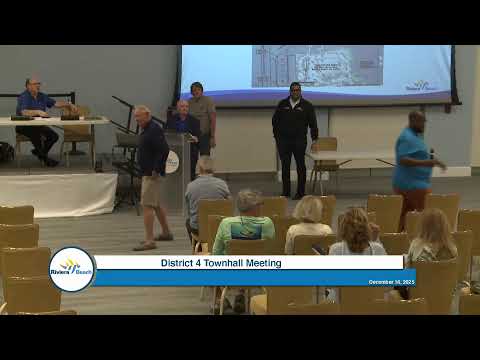
Riviera Beach officials told residents at a District 4 town hall that the city intends to open two managed mooring fields, augment marine enforcement and use third‑party management to reduce pollution and safety risks from improperly moored or derelict vessels.
City Manager Jonathan Evans introduced a multi‑agency enforcement and operational approach that draws on a nearby North Palm Beach success. "We are going to be taking a more proactive, more aggressive approach," Evans said, listing nighttime and weekend patrols, dye testing and underwater drones as part of the ramped enforcement plan.
Detective Shane Myers of North Palm Beach described removing dozens of problematic moorings in his jurisdiction. "We were successful in removing 18 out of 19 boats from the bay," he said, and credited coordinated enforcement and removal procedures for improving safety and water quality.
Randy Sherman, the city’s finance director, and consultant John Sprague described the management plan that FDEP attached to its approval for a mooring field at Phil Foster Park. The approved permit originally included positions for 51 moorings; staff said they will omit at least 10 of the outer positions to increase buffer distance from shore and that the city plans to further reduce the field footprint to roughly 25–30 moorings based on community input and design constraints. Sherman said the management plan will be codified into city ordinances and enforced by a private contractor with the police department providing marine enforcement support.
Technical design details include helical anchors to limit chain‑on‑bottom seagrass damage, annual inspections, differing mooring classes sized for vessel depth and a requirement that mooring users provide proof of registration, insurance and compliance with safety lighting. The city budget includes funds to expand the marine unit to multiple officers and to acquire two pump‑out vessels to prevent sewage discharge from boats.
Residents questioned how existing anchored boats will be managed. City staff said vessels already in place will have priority to lease and must meet the management plan’s registration, insurance and rotation rules; if they fail to comply they are subject to enforcement under Florida law. Staff also committed to redesigning the field to reflect neighborhood concerns about noise, channel width and wildlife, and to additional outreach in Sugar Sands and adjacent neighborhoods.
Officials said DEP and the U.S. Army Corps of Engineers remain part of the permit process and that timeline uncertainty is driven by those agencies’ review cycles. The city pledged follow‑up meetings after the New Year to present the redesigned plan and to share permit documents and the approved management plan online.
If implemented, the managed mooring fields and stepped‑up enforcement will combine operational changes (pump‑outs, manager oversight) with policing (marine unit expansion) and regulatory controls (leasing, insurance, rotation) to address derelict vessels and localized pollution.