Schenectady board hears plan to launch dual language Spanish/English program in fall 2026
Summary
District officials presented a dual language/bilingual education plan that will begin in kindergarten in fall 2026 using a 50/50 Spanish‑English model, expand one grade per year, include slots reserved for English‑only students, and include professional development and monitoring plans.
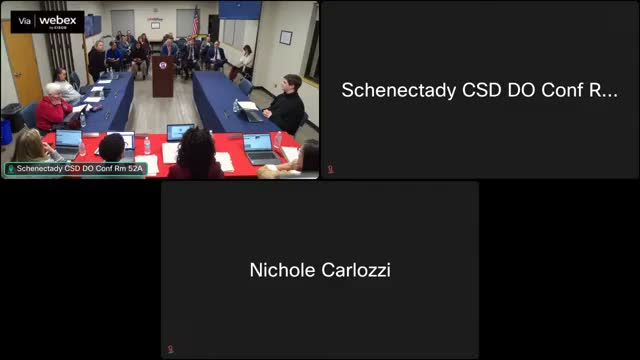
Schenectady City School District officials outlined the district’s planned dual language bilingual education (DLBE) program at the Dec. 17 board work session, saying the program will begin in kindergarten in fall 2026 and grow one grade per year. Assistant superintendent (presenting) and Leah Akalayev, introduced as director for innovation, equity and engagement, described curriculum, staffing and outreach steps already under way.
Officials reported the district’s current English language learner (ELL) population as 503 and highlighted program goals including bilingualism, biliteracy and cultural competency. On the model, staff said, “We are doing a 50 50 model,” meaning roughly half the day or content will be taught in Spanish and half in English. The district plans curriculum allocation with math delivered in Spanish/English alignment, science in English, and social studies in Spanish; SEL and specials have mixed language plans.
Enrollment, equity and policy questions: staff described a lottery with seven seats reserved for non‑ELL (English‑only) students and emphasized that ELLs are prioritized by law. On family continuity, staff said they would explore language to provide consideration for multilingual families and clarified that parents (not students) may opt a child out of the dual language program while ENL services remain a right. A board member asked for clearer policy language on sibling/family considerations and staff agreed to check legality and possibly refine wording.
Implementation, staffing and monitoring: district staff said they have hired teachers early to support retention and planned professional development including conferences, site visits and a state bilingual‑program toolkit to monitor fidelity. Staff also discussed use of instructional technology and AI tools as translation and instructional supports — noting resources and guidance will be provided and that AI will be used as a supplement, not a substitute for bilingual instruction.
Outreach and next steps: the district said it will produce parent outreach materials (videos and orientations) and hold mandated parent orientations; the board was asked to review policy at a January second reading expected Jan. 5 and to support outreach and monitoring work.
Ending: staff emphasized a measured rollout — starting with a single kindergarten strand and a two‑teacher model — and said they will return with policy refinements, research and monitoring plans ahead of the program’s fall 2026 launch.