NFP Review Board Recommends ZBA Grant Variances for Westgate Sports Complex with Native-Planting Condition
Loading...
Summary
The NFP Review Board voted to recommend the Zoning Board of Appeals grant variances allowing a 20-acre Westgate Sports Complex at 1617 North Drake Road to preserve 13.5% of woodland (where 25% is normally required) and to permit protected-slope impacts, adding a condition that remaining green areas include native plantings. The recommendation moves the project to the ZBA in January; site plan review and additional approvals would follow.
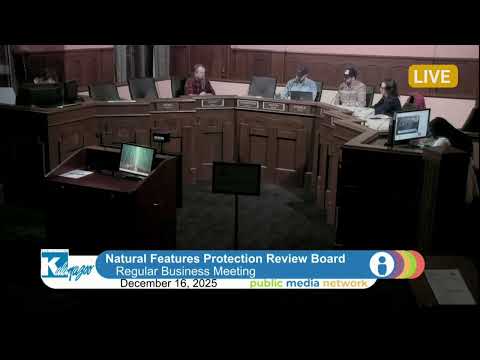
The NFP Review Board recommended on Dec. 16 that the Zoning Board of Appeals grant two variances for a proposed Westgate Sports Complex on a 20-acre portion of a 62-acre parcel at 1617 North Drake Road.
Nolan, the city staff presenter, told the board the applicant seeks a variance to preserve 13.5% of the woodland on the 20-acre lot where the Natural Features Protection (NFP) ordinance would normally require 25% preservation, and a variance to allow impacts to protected slopes and slope setbacks within the project limits. The staff report framed the board’s role as advisory; final authority rests with the Zoning Board of Appeals.
The project team said the facility is intended as a regional sports hub and outlined why the chosen site on the city’s northwest edge was preferred: highway access (US‑131), room for a large indoor court complex and proximity to hotels and restaurants. Jane Ghosh, president and CEO of Discover Kalamazoo, said a feasibility study validated local demand and that "we will have about almost 225,000 non local attendee days" and an economic impact "of almost $50,000,000," adding the funding model relies on a visitor-paid hotel assessment under the Event Center Financing Act.
Kurt Artema of AVB and Laurie from Hurley & Stewart described site constraints: the parcel was partly cleared decades ago for a cemetery project; large grade changes (about 41 feet) create stormwater and siting challenges; and a perimeter drive is required for emergency access. Engineers estimated that a potential future extension of Maple Hill Drive by the county could add roughly 2.5 percentage points to the cleared area — dropping the proposed preserved woodland on the 20-acre parcel from about 13.5% to roughly 11% if that road were built.
On parking, the project team said an early feasibility target of about 950 spaces was later reduced in design work to roughly 650 spaces to balance tournament needs with tree preservation. The team also said county road commission rules preclude on‑street overflow parking on county roads and that structured parking would be economically infeasible and likely conflict with the RS‑5 zoning height limit.
Board members pressed the team on woodland loss, fragmentation and ecological impacts of increased edge habitat; native landscaping; bird‑safe glass; and how residents (not just hotels and restaurants) would benefit. The project team responded that midweek local use would be prioritized and that native plantings and bird‑safe glazing are being considered in design and focus groups.
After discussion, Speaker 2 moved to recommend the variances for protected slopes/slope setbacks and for the woodland standard (to preserve 13.5% instead of 25%), with Speaker 5 seconding. Director Bassett proposed adding a condition that "as much of the remaining green space as possible" be planted to native species, and the motion was amended to include that condition. The roll-call entries recorded in the transcript show Mercia voting "Yes," Martin "Yes," Stemple "No," and Bassett "Yes." The chair moved on after the vote; the recommendation will go to the Zoning Board of Appeals in January. If the ZBA grants the variances, the project will return to the city for site plan review and any additional, itemized approvals.
The project team identified partners including Discover Kalamazoo, the Kalamazoo County Event Center Assessment District (KCAD), Michigan Department of Transportation and the Kalamazoo County Road Commission. They described a funding structure based on a county bond repaid by an incremental hotel assessment applied to properties with at least 35 rooms; presenters said hotel owners approved the assessment in a county referendum.
What’s next: the variances are scheduled to go to the Zoning Board of Appeals in January. If granted, the project will enter site plan review, during which the board and staff expect more detailed landscape, tree‑protection, stormwater and circulation plans to be submitted.