Get Full Government Meeting Transcripts, Videos, & Alerts Forever!
Get email alerts on the Housing Development topic
No spam. Unsubscribe anytime.
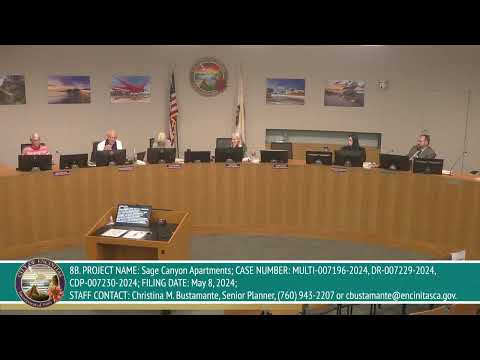
Encinitas planning commission approves 120‑unit Sage Canyon project but denies developer concession to omit El Camino Real frontage improvements
Summary
After extensive testimony from staff, fire officials, residents and the developer, the Planning Commission approved a 120‑unit apartment project in Sage Canyon but denied the developer's request to omit required frontage improvements on El Camino Real, finding such omission would cause unmitigable public safety impacts; the motion carried 4‑0 with one recusal.
The City of Encinitas Planning Commission voted on Jan. 7 to approve a 120‑unit multifamily project (Sage Canyon) on a 5.23‑acre site in New Encinitas while denying the developer's requested density‑bonus concession that would have allowed the project to avoid constructing standard public frontage improvements on El Camino Real.
Senior planner Christina Bustamante told the commission the project seeks a design review permit, a density‑bonus request (six waivers and one concession), a coastal development permit and an exemption from CEQA for a 120‑unit apartment development. Bustamante said the applicant proposes 24 low‑income units (20% of the total); 22 of those would be deed‑restricted in perpetuity under local inclusionary rules and two restricted for 55 years, with the remainder of program details recorded in project conditions.
City engineer Dan Nutter summarized the technical basis for staff's public‑safety conclusion, citing city circulation standards, roadway design standards, Federal Highway Administration and AASHTO guidance as well as local speed surveys — "we've got over, 40 citations or so," he said — and the city engineer's memorandum concluded that omitting the frontage work would cause "significant adverse public health and safety impact that cannot be mitigated." The Coastal Commission also submitted a letter (Dec. 15, 2025) urging public infrastructure improvements that protect safety and water quality.
Fire Chief Josh Gordon told the commission that in a major conflagration El Camino Real functions as an evacuation corridor in unified command operations and that wider lanes and reliable evacuation routes are necessary: "it is an evacuation corridor," he said, adding that contraflow is difficult to manage and that preserving northbound lanes for incoming response resources is critical.
The developer's attorney, Tim Hutter of Allen Matkins, argued the commission must make an objective, quantifiable finding of a "specific adverse impact" under state density‑bonus law to deny a concession and suggested the staff analysis did not meet that legal threshold. Hutter described the project's traffic estimates — roughly 68 additional pedestrian/bicycle trips and about 720 vehicle trips daily — as evidence that the record lacks a specific, quantifiable adverse impact linking the concession to unmitigable harm.
Multiple residents urged denial of the concession in public comment, focusing on pedestrian and bicycle safety on El Camino Real, evacuation risk during wildfire, visual impacts of tall retaining walls and potential harm to sensitive habitat near Lux Creek. One commenter, Stuart Grower, asked whether the commission could find "there's no possibility of significant environmental impact," noting that "CEQA's no possibility exemption. That requires factual certainty."
After deliberation, Commissioner Susan moved to adopt the draft resolution approving the project while denying the requested concession and conditioning approval on design and construction of the standard public improvements on El Camino Real; the motion carried 4‑0 (one commissioner had recused). The resolution includes findings that omitting the vehicle lane, sidewalk, curb and gutter, and bicycle lane modifications would cause a significant, unmitigable public‑safety impact.
Next steps: the action is a Planning Commission discretionary approval; the project remains subject to post‑entitlement engineering, conditions recorded against the parcel (open‑space easements, habitat mitigation requirements), and Coastal Commission coordination. The developer may seek City Council review or pursue available appeals.