
Resident presses Hubbardston officials for explanation of $101,000 property assessment increase
Get AI-powered insights, summaries, and transcripts
Subscribe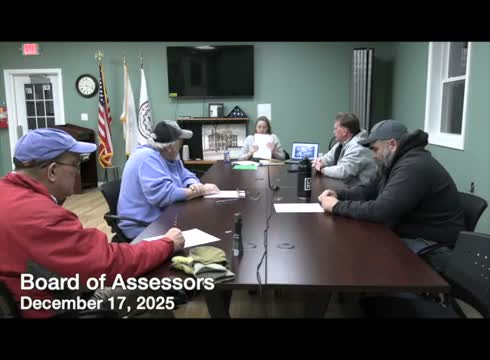
Summary
At a Town of Hubbardston meeting, a resident identified as Ed challenged a $101,000 (26%) increase in assessed value for 56 Barry Road, criticized the town's abatement process and use of executive sessions, and said he has appealed to the Appellate Tax Board after receiving no specific justification from assessors.
Ed, a local resident, told the Town of Hubbardston that he has asked repeatedly for a specific explanation for a $101,000 (26%) increase in the assessed value of his property at 56 Barry Road and has filed an 85‑page appeal with the Appellate Tax Board (ATB). "Since the beginning of this year, I've tried to get a specific reason for the $101,000 26% increase on my property at 56 Barry Road," he said during the meeting.
Ed said he allowed an inspection that produced a $15,000 condition reduction, submitted comparative data at an assessors' meeting, and received no further communication; he said the board voted in executive session not to grant any further abatement. "Holding abatement hearings only in executive sessions gives the applicant no feedback whatsoever," he said, and asked what could be done to help taxpayers understand the process.
Board members and staff replied that executive sessions for abatement deliberations are permitted under state law and that the town relies on its contracted assessing firm to provide comparables and statistical information. "The purpose of allowing the board under Mass General Law to go into executive session ... is to avoid confrontation," one member said, explaining why deliberations often occur behind closed doors. The transcript alternately refers to the contracted assessor as "RNG" and "RRG." Ed said he had been given only general explanations, such as that similar property categories rose by 30%, and he disputed the relevance of the comparables used because his two houses are on one lot, served by one well and one septic.
The meeting record shows no formal vote on Ed’s case in open session; at least one assessor said the board discussed his abatement in executive session after he left. Ed said he sought a clearer, written explanation from assessors and asked the town to consider process changes so applicants receive substantive feedback.
The meeting scheduled the next session for Jan. 21 at 6 p.m., and later included a motion to enter executive session that was proposed and seconded on the record; the provided transcript ends before a roll-call or outcome is recorded.