
Woburn committee adopts elementary buffer zones for 2026–27; middle-school changes delayed
Get AI-powered insights, summaries, and transcripts
Subscribe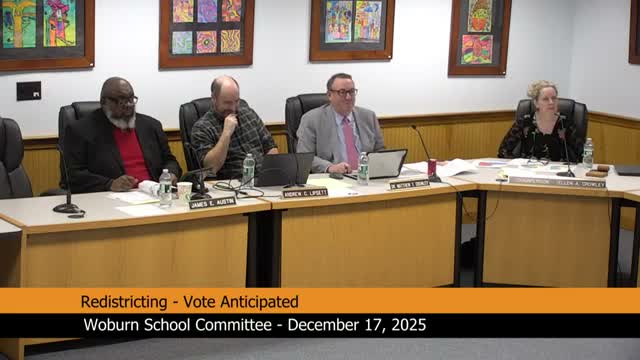
Summary
After public testimony and staff presentations, the Woburn School Committee voted 5–1 to institute buffer ("gray") zones for elementary school assignments in 2026–27, grandfathering current students and applying new maps only to new enrollments; committee deferred middle-school changes until next year.
The Woburn School Committee voted Dec. 17 to institute buffer — or "gray" — zones for elementary school assignments in the 2026–27 school year, approving the measure 5–1 after public comment and staff presentations.
Assistant Superintendent Courtney Young told the committee the vote would set a direction rather than finalize specific boundary lines: "All students currently living in these components would be grandfathered in," she said, adding that the district would finalize implementation plans in January and notify families by April 1. Young described buffer zones as a tool to assign new enrollees while preserving stability for students already attending a school.
Several parents urged the committee to adopt buffer zones. Alex Tisdale, a parent representative, said flexible assignment areas "provide a balanced approach that helps manage enrollment changes, reduce overcrowding, and preserve stability for schools and families over time." Public commenter Morgan Kuberry, reading for Rachel Kuberry, told the committee one middle school was about 25% larger than the other, arguing buffer zones could help address such imbalances.
During deliberations, members raised practical concerns: Vice Chair Chisholm asked how long families in a buffer might live 'in limbo' and warned about busing costs; Mister Lipsett and others noted buffer zones preserve flexibility but may require annual review. After discussion, School Committee member Miss Cormier moved to institute gray/buffer zones for the elementary schools as outlined by Young; the motion passed on a roll call vote 5–1, with Miss Crowley recorded as the sole no vote.
The committee separately considered but declined to change middle-school assignments for next year. An initial motion to institute gray zones at the middle-school level produced a 3–3 split and was followed by a subsequent motion — also put to the committee — to take no action for the 2026–27 middle-school year; that motion passed 4–2.
Next steps, Young said, include finalizing which components will serve as buffers during January and February, communicating the adopted approach to stakeholders, and providing specific family notifications by April 1.
The committee adjourned the redistricting discussion with instructions to review outcomes after one year to determine whether buffer zones are sufficient or whether components must be fully redistricted.