Get Full Government Meeting Transcripts, Videos, & Alerts Forever!
Get email alerts on the Highway Operations topic
No spam. Unsubscribe anytime.
Highway department details winter operations, brine plan and $3.8M equipment backlog
Summary
Sawyer County highway staff reported recent winter work, outlined a strategic plan to reduce salt use via a brine system (state will fund brine equipment but not buildings) and a consultant presented an equipment analysis citing a $3.8 million backlog and multi-year turnover needs.
Sawyer County Highway Department staff delivered a detailed winter-operations and equipment briefing during the Public Works Committee meeting, outlining recent storm response, plans for a brine system to cut salt use, and a consultant's assessment of the county's equipment backlog and turnover needs.
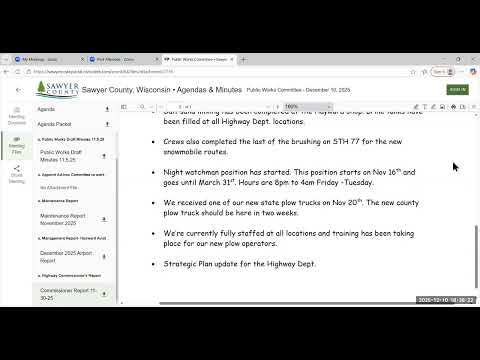
John (highway department staff) told the committee crews had been busy with multiple snowstorms and freezing rain, had cleared downed trees, completed brushing work on specified road segments and replaced a culvert for a village. The department reported filling brine tanks at highway department locations and taking delivery of a new county plow truck; the county truck was expected to enter service the following week.
John described a strategic plan that includes line-item budget review, evaluating operational efficiency across three highway facilities, workforce retention measures and consideration of a brine-making capability at county sites. He said the state would fund brine-making equipment and tanks but would not fund the county building where it would be housed. John estimated labor costs for preparing trucks for each snow event (hooking/unhooking plows) at roughly $1,200 without overtime and $1,800—$1,900 with overtime per storm, noting those figures exclude equipment and fuel.
Consultant Bill Curtin, identified in the meeting as a former Sawyer County highway commissioner brought in to analyze fleet management, presented a spreadsheet-based review of the county's equipment. Curtin reported 66 pieces of primary equipment in the fleet, an average plow-truck age of about six years, an equipment purchase backlog of approximately $3,800,000 and first-year turnover needs near $5,800,000. Curtin described a multi-year turnover plan, utilization tracking and steps to move the county away from a guaranteed-cost arrangement that the consultant said can reduce incentives to create revenue from state trucks during summer months.
Committee discussion raised operational options, including configuring trucks for dual use to generate more summer revenue and adjusting plow routes, and reviewed the possibility of satellite shops and a new main facility to improve efficiency. Committee member questions confirmed that crews remove plows at the end of each snow event to fit trucks into existing shops; presenters said that practice contributes to labor expense and would be addressed through facility and operational changes.
Committee members thanked the presenters; the highway segment concluded with an agreement to continue evaluating the budget, equipment utilization and facility options in coming months.