Get Full Government Meeting Transcripts, Videos, & Alerts Forever!
Get email alerts on the Food Waste Policy topic
No spam. Unsubscribe anytime.
MassDEP proposes two-stage expansion of food-waste disposal ban; stakeholders press on capacity and enforcement
Summary
MassDEP staff proposed a two-stage plan to expand the state's food-waste disposal ban'first lowering the commercial threshold and later covering residential waste'and solicited stakeholder input on capacity, enforcement, school contracting and funding support.
BOSTON ' MassDEP staff on a stakeholder call outlined a two-stage proposal to tighten the state's food-waste disposal rules and asked municipalities, haulers, schools and recyclers to weigh in on capacity, enforcement and implementation.
John Fisher, who led the discussion for the Massachusetts Department of Environmental Protection, said the agency is considering a first step that would effectively lower the commercial organics threshold to a zero-like standard for businesses and institutions with food-service operations, and a second step, no sooner than 2030, that could extend a universal disposal ban to residential food waste. "Food waste is, as probably most of you know, the single largest material in our solid waste stream," Fisher said, noting the state produces roughly 930,000 tons of food waste annually and has a 2030 diversion goal of 780,000 tons.
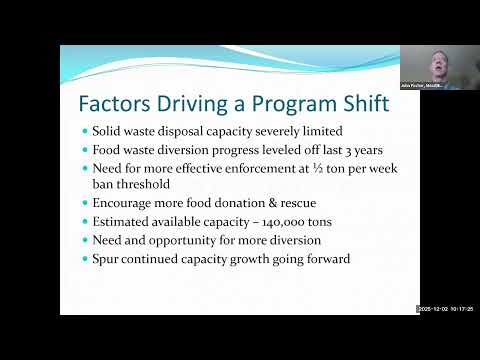
Why it matters: MassDEP staff said in-state handling capacity is limited and unevenly distributed. Fisher estimated current Massachusetts capacity at about 500,000'510,000 tons, with a neighborhood of 140,000 tons currently available; he said the state would need roughly 270,000 additional tons of capacity to meet the 2030 goal. "We do expect this process to extend into 2026," he added, underscoring that the proposal is at an early, discussion stage.
Stakeholders pressed MassDEP on three linked challenges: where additional processing capacity will be sited and permitted, how to prevent contamination as collection expands, and how enforcement will work in practice. Phil Goddard urged MassDEP to publish a regional inventory of capacity (AD, composting and by region) and to examine land, permitting and developer constraints so private operators can plan projects. One participant warned that inspections at transfer stations can miss generator-level noncompliance when food is placed in sealed bags.
On contamination and technology, Fisher and participants discussed depackaging facilities and co-digestion at wastewater plants. Fisher said depackagers can divert packaged food when separation is technically feasible but cautioned the quality of the output and its appropriate end uses must be evaluated. He also noted the Bureau of Resource Protection is developing regulations on wastewater residuals that could affect co-digestion.
Funding and technical assistance: MassDEP described multiple support streams to grow infrastructure, including Recycling and Reuse Business Development grants (historically up to $400,000, under review for a higher cap), a Recycling Loan Fund (loans up to $500,000, with potential cap increases under consideration), and dedicated loan support for anaerobic digestion projects (up to $1.5 million). Fisher pointed to Recycling Works Massachusetts as a no-cost technical-assistance program that helps businesses and municipalities set up diversion programs. "We provide this service, at no cost to the business or institution, because, again, we are funded by the DEP," said Steve Bandera of Recycling Works.
Schools and procurement: Several participants urged MassDEP to coordinate with the Department of Elementary and Secondary Education so school food-service contracting can include sustainability and diversion requirements. Amber Keller, a waste-reduction coordinator for two districts, said DESE's current RFP template for food-service management does not include sustainability measures and recommended adding contract language to support donation and composting efforts.
Enforcement and municipal compliance options: Fisher said MassDEP's current approach relies on inspections of incoming loads at solid-waste facilities and on focused enforcement where banned materials appear significant. He said a 0-threshold approach would let the agency cite significant banned material without calculating a generator's weekly tonnage, similar to enforcement for cardboard and containers, and stressed the agency typically does not pursue enforcement actions against individuals.
Next steps: MassDEP will continue sector-based outreach, follow-up meetings on infrastructure and implementation topics, update guidance and the organics action plan, and post the meeting recording and presentation on its website. Fisher said the agency plans additional meetings roughly every six to eight weeks and tentatively expects another convening in January.
The meeting produced no formal votes or regulatory decisions; MassDEP described the proposal as informal and invited written feedback and follow-up meetings from municipalities, haulers, food-service operators and other stakeholders.