Get AI Briefings, Transcripts & Alerts on Local & National Government Meetings — Forever.
MassDEP: 2024 data show flat in‑state disposal, rising exports driven by construction debris
Summary
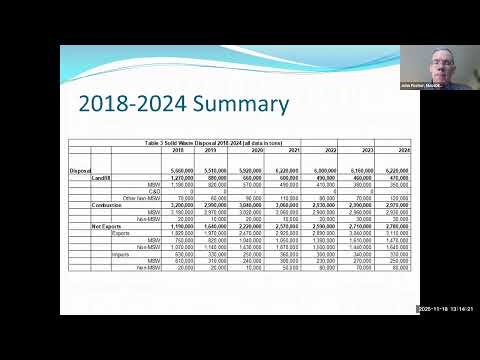
MassDEP analysis of 2024 facility reports shows overall disposal largely unchanged year‑to‑year, but a roughly 70,000‑ton rise in net exports and a shift toward higher non‑MSW (construction and demolition) exports that are driving most of the increase.
Massachusetts Department of Environmental Protection officials told the Solid Waste Advisory Committee on Nov. 18 that statewide disposal totals for 2024 were broadly unchanged from 2023 but that exports of Massachusetts‑generated waste to out‑of‑state disposal sites increased.
"We've not made progress on overall disposal reduction," John Fisher, who presented the data, said, noting a modest year‑to‑year uptick of about 60,000 tons and a reported net export increase of roughly 70,000 tons from 2023 to 2024. Fisher said the state records nearly 2,800,000 tons of net exported disposal when measured across the dataset presented to the committee.
Why exports rose: Fisher and the presentation identified two main drivers. First, municipal solid waste (MSW) fell by about 140,000 tons from 2023 to 2024, while non‑MSW — primarily construction and demolition (C&D) materials and some contaminated soils — rose by about 200,000 tons. "The non‑MSW increase combined with the MSW reduction is basically what gives you that net increase," Fisher said. Second, long‑term reductions in in‑state landfill capacity and the earlier closure of small municipal waste combustion facilities have left less in‑state disposal capacity, increasing dependence on out‑of‑state options.
Where the waste goes: The presentation included import/export charts showing Massachusetts waste moving to many states by rail and truck; non‑MSW exports were especially concentrated toward Ohio, while closer states such as Connecticut, New Hampshire and New York received material by truck. Fisher said the distribution of destination states and rail transport capacity has grown over the last five to six years.
Scale and trend context: Extending the comparison back to the 2018 baseline used in the state Master Plan, Fisher said total disposal increased by about 500,000 tons from 2018 to 2024 (roughly a 10% rise), driven mainly by non‑MSW growth. He suggested this shift is why meeting the 2030 disposal‑reduction goal would likely require focusing on net exports and non‑MSW streams rather than in‑state disposal alone.
Data caveats and QAQC: Fisher repeatedly noted the underlying numbers are rounded and drawn from facility annual reports and cross‑checked where possible; he flagged a few data points for QAQC during the meeting (for example, ash reporting anomalies at particular combustion facilities) and said MassDEP will follow up and revise the published tables if necessary.
What happens next: MassDEP said the presentation slides and final report will be posted on the SWAC webpage and the department's YouTube channel after QAQC. The agency also plans to publish a fuller PDF of the data within about a week of the meeting.
This presentation frames a central challenge for Massachusetts' 2030 goals: rising volumes of construction‑sector waste and constrained in‑state disposal capacity appear to be key drivers of export growth, which the state will have to address through a mix of source reduction, market development for recovered materials and management of cross‑state disposal flows.