Get Full Government Meeting Transcripts, Videos, & Alerts Forever!
Get email alerts on the Local Infrastructure Reconstruction topic
No spam. Unsubscribe anytime.
San Mateo County outlines three reconstruction options for 4th Avenue; property-owner survey due Dec. 17
Summary
County public-works staff presented three ballot options for reconstructing 4th Avenue in North Fair Oaks, explained funding limits (SB1 and mitigation fees), and answered residents’ questions about sidewalks, drainage and vote thresholds; surveys for property owners are due Dec. 17.
San Mateo County Department of Public Works staff on a community webinar presented three reconstruction options for 4th Avenue in the unincorporated North Fair Oaks neighborhood and urged property owners to return mail ballots by Wednesday, Dec. 17.
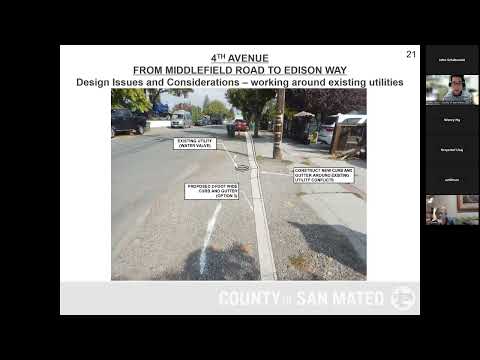
Carter Choi, principal civil engineer, said the project would rebuild 4th Avenue between Middlefield Road and Edison Way and that property owners will vote by front footage on three options: maintain the street as-is (Option 1), reconstruct with 33 feet of pavement and 2-foot concrete curb and gutter (Option 2), or reconstruct with 37 feet of pavement and 2-foot curb and gutter (Option 3). Choi said property owners are responsible for driveway work beyond the back of curb and for sewer-lateral repairs to the sewer main in the street.
The county said funding for the work will come from SB 1 and roadway mitigation fees and is limited to roadway reconstruction, concrete curb and gutters, valley gutters and minor concrete work; those sources cannot pay for landscaping, additional shoulder work or homeowner driveway improvements beyond project limits. Choi said the county plans to review survey results in December and January, complete design with a goal of awarding a contract and beginning construction in 2026, and that the schedule could be affected by coordination with utilities or winter storm damage.
Several residents raised accessibility and safety concerns. Natalie, a resident who spoke for her 85-year-old grandmother, said the family often walks in the roadway because sidewalks are narrow or non-existent and asked whether the wider Option 3 would make walking worse. Choi and other staff were clear that constructing new sidewalks is not part of this reconstruction project; Choi said, "We will not be constructing new sidewalks," and Anne Stillman, director of public works, said sidewalks are typically a property-owner responsibility and that road-fund sources used for this project cannot pay to install new sidewalks.
Residents also asked about speeding. Christophe Leifai, deputy director, posted a link to the county’s traffic-calming program and encouraged residents to submit an application for a speed study; he said there is a cost for such an analysis and described types of traffic-calming measures the county evaluates.
Staff described drainage issues on 4th Avenue (localized ponding in shoulder low points and no underground street drains) and recommended Options 2 or 3 would allow the installation of curb-and-gutter and, where feasible, subsurface infiltration galleries (green infrastructure) required by the California Regional Water Quality Control Board to treat stormwater.
The meeting included detailed but inconsistent explanations of how the survey results determine next steps. In the presentation Choi said that a property owner who does not return a survey is counted as an Option 1 (maintain as-is) vote and earlier stated that "if none of the option receives at least 50% of the vote, the default option will be Option 2." Later in the question-and-answer period staff clarified the decision rule they will apply: the first threshold is whether more than 50% of property-owner front footage votes in favor of improvements (Options 2 or 3 combined). If more than 50% of front footage supports improvements, the county will select whichever of Options 2 or 3 has the larger share; if fewer than 50% of owners want improvements, the block will not move forward with reconstruction and the street will remain on the county’s maintenance schedule (seal or minor repairs). Choi and staff encouraged neighbors to discuss options block-by-block and to make a concerted effort to get property owners to submit their ballots.
Choi said the county sent 42 surveys to addresses on 4th Avenue and that staff had received roughly a dozen responses at the time of the meeting, so residents were urged to help reach an estimated 20–25 returning ballots to determine a clear outcome for particular blocks. Staff also said they will post answers to the chat questions in a FAQ page on the project website.
No formal county decision or vote occurred at the meeting; the project's next procedural steps are collection of property-owner surveys, staff review of results in December and January, and design and bidding with the county’s goal of construction in 2026.