
Leavenworth USD 453 projects $2 million shortfall; trustees direct staff to study elementary closure and grade reconfiguration
Get AI-powered insights, summaries, and transcripts
Subscribe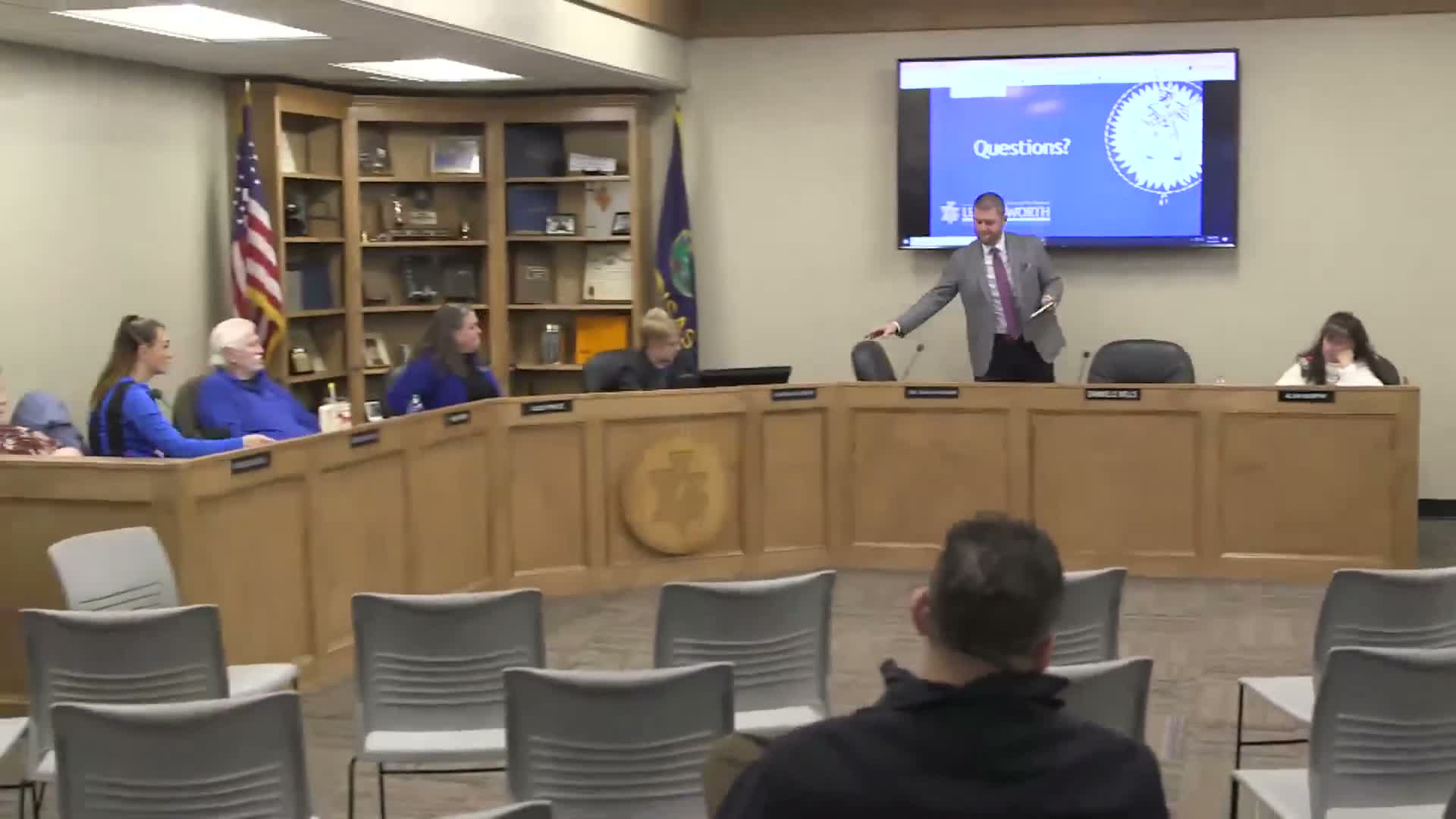
Summary
Superintendent Kellen Adams told trustees Dec. 8 the district faces an estimated $2 million gap tied to falling enrollment. He presented four options — including closing an elementary, repatriating grades and an alternative school — and the board directed staff to focus on options 1 and 2 for further study.
Leavenworth USD 453 Superintendent Kellen Adams told the board at its Dec. 8 meeting that the district faces a sizable budget shortfall driven by falling enrollment and the way state school finance adjusts with inflation. "We used to be a system of over 4,000 students," Adams said; he presented an unaudited enrollment figure "just barely over 3,000" and said the district’s working gap is "let’s call it a nice even $2,000,000."
Adams said projected revenue tied to the school finance formula was about $700,000 so far and described roughly $607,000 in payroll tied to positions the district has temporarily frozen. He told trustees the administration had used internal and external surveys to develop a set of response options and previewed four approaches to reduce costs or retain students. "Option 1 is going to be we will entertain closing one of the elementary buildings," Adams said, stressing that savings only accrue if the district reduces its overall operational footprint rather than merely moving students between buildings.
Option 2 would "reimagine" the current intermediate (fifth–sixth) campus by repatriating fifth graders to home elementary schools and possibly moving sixth graders to the middle school. Adams said fifth‑grade rollover for the coming year would be about 219 students and sixth grade about 209 under a "pure rollover" model. Option 3 — vacating Lawson and shutting the early childhood center — was presented as a stakeholder idea but not recommended by administration. Trustees removed Option 3 from active study after several members noted that Lawson was recently built under the district’s bond program. Option 4 would study a comprehensive alternative education setting (K–12) intended to regain students who have left the district because of climate or behavioral concerns; Adams said that option would not produce near‑term budget savings.
Board members repeatedly pressed Adams on capacity and transition costs, retrofit needs and the political implications of closing or repurposing recently built facilities. Adams warned that moving students without reducing square footage would not yield meaningful savings: "Simply moving all of the students from one elementary to another does not represent a cost savings," he said. He also noted the district loses "north of $10,000" in revenue for each student who leaves, framing enrollment recovery as a potential offset to some costs.
After discussion the board agreed to remove Option 3 from consideration and to concentrate staff effort on developing detailed analyses for Options 1 and 2. Trustees asked that the administration’s departmental review include: estimated one‑time and ongoing savings, any increased transitional costs, political/community ramifications (for example redistricting and neighborhood impacts), and operational constraints such as space retrofits. Adams said an enrollment study is expected back in mid‑January and that a separate work session should be scheduled to review the study and the administration’s reports before the board makes any final decisions.
Next steps: the administration will return detailed pros/cons, estimated savings and transition costs for the focused options, informed by the January enrollment study. The board did not take a final vote on closures or reconfigurations at the meeting.