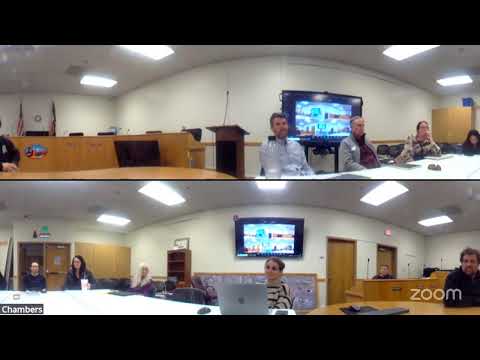
Advisory board backs using RCG money to jump-start county economic development capacity
Loading...
Summary
The Economic Opportunity Advisory Board discussed directing $200,000 in Rural Communities Grant (RCG) funds to rebuild an economic development department — including a one-time $50,000 compensation line and roughly $150,000 for programs and data work — and set contract and reporting timelines for awardees.
The Economic Opportunity Advisory Board discussed a plan to use Rural Communities Grant funds to rebuild county economic-development capacity and to require earlier, standardized reporting from subgrantees.
Melissa Jeffers, county economic development staff, told the board she has drafted the RCG process and contract templates and is waiting on county attorney review. She said the commission adopted a budget that includes using $200,000 of RCG funding this year for the newly organized department. "Part of it will cover a portion of that compensation, and then part of it will be our budget to be able to renew the memberships and make the investments that we need," Jeffers said.
Why it matters: County leaders said up-to-date economic data will be critical to attract investment and to measure program impact. Jeffers said the county is working with EDC Utah for a custom community profile and with Zions Public Finance for sales-tax leakage reports so the county can quantify needs and priorities to state and federal partners.
Budget details and constraints: Board members identified a one-time $50,000 line for staff compensation and roughly $150,000 for programming and capacity-building. Melody McCallis, who reported the commission adopted the budget, noted the county faces a roughly $2 million shortfall; the RCG allocation is intended to plug an immediate gap while staff seek sustainable revenue. Several board members pressed for clarity on whether staff funding would continue beyond the one-time RCG allocation. "If this is a grant-funded position and the grant no longer allows the position to be funded, then the county's put in a position where they say, to fund Melissa next year, 2027, we need to cut somebody else," said Chris Wilson, a board member, expressing concern about relying on one-time funds.
Reporting, monitoring and timing: The board debated contract terms and reporting deadlines. Jeffers recommended aligning internal deadlines with state reporting windows and proposed an annual reporting requirement; board members proposed a May 1 preliminary report and a mid-term check-in to give the board time to identify red flags before final reporting is due in July. Members also discussed whether grants should be reimbursable, offered as partial advances (for example, 25%), or paid up front for projects that cannot cash-flow operations.
Project readiness and short contract windows: Board members cautioned that the county's expected schedule (payments in January and projects completed by June/July to align with GoYO/EAG reporting) favors projects that are already 'shovel-ready' and may exclude longer-lead projects. "If you have a project already decided, it's ready to go," one member said; others warned a five- to nine-month timeline limits the pool of viable applicants.
Next steps: Jeffers will circulate contract drafts once legal review is complete and will notify the board when contracts are issued. The board agreed to require a light midway check-in (an emailed status update) from awardees and to review those updates at the March meeting to decide whether to offer technical assistance or reallocate funds. No formal vote was recorded at the meeting.
Context and caveats: Board members repeatedly emphasized this is an interim, one-time use of RCG funds intended to build internal capacity and data systems; several said the ultimate goal is to generate revenues that could be incorporated into recurring county budgets. The advisory board will continue refining reporting questions and subgrant criteria as staff return contract drafts and data products from EDC Utah become available.