
Scott County Ditch Board pauses abandonment proceedings for County Ditch No. 4 after Credit River votes to seek transfer
Get AI-powered insights, summaries, and transcripts
Sign Up Free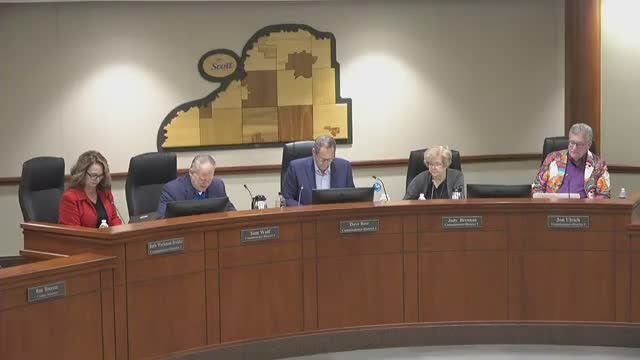
Summary
The Scott County Ditch Board voted to continue the abandonment proceedings for County Drainage Ditch No. 4 indefinitely after Credit River council voted to pursue a petition to transfer the ditch; the city said it would not accept pre-transfer liability, and an engineer's report (statutory requirement) was estimated at roughly $20,000.
The Scott County Ditch Board voted on Dec. 16 to continue indefinitely the public hearing on County Drainage Ditch No. 4 after the City of Credit River’s council moved to seek a petition to transfer the ditch to the city.
Chair (unidentified) opened the meeting and called the continuation of the public hearing on Ditch No. 4, noting Credit River council had discussed petitioning for a transfer. Chris, present to report for the city, told the board Credit River staff voted to bring a petition forward and asked for county support preparing the petition and the engineering report required by statute.
Chris said the city was “adamant” it would not accept liability for incidents occurring before the transfer and expected the county or ditch authority to remain responsible for any events up to the point of transfer. Chris also reported council questions about buffer requirements along public waterways and said the city’s engineer had not previously enforced buffer law in the same way a municipality might for other infrastructure.
Ditch Board attorney John Kolb outlined the statutory process and likely effects of a transfer. Kolb said state buffer law (chapter 103f) distinguishes ditch buffers (commonly 16.5 feet) from buffers on public waters (50 feet) and that enforcement responsibilities may rest with the state Board of Water and Soil Resources and the local soil and water conservation district if local authorities have not assumed enforcement. He said those buffer rules should not be treated as a barrier to transfer.
Kolb also described the petition requirements under the drainage statute (referencing the statutory engineering-report requirement). He said the engineer’s report must describe the drainage easement, constructed or subsequently improved depth and hydraulic capacity, and the petition’s expected impacts on properties served by the system. Kolb estimated that assembling the necessary engineering documentation could cost in the neighborhood of $20,000 if outside consultants were hired, though he added the figure could be lower or higher depending on scope.
On a procedural recommendation from Kolb, the board moved and approved continuing the abandonment proceedings indefinitely while awaiting a petition and an associated engineering report; if a petition is filed, the transfer petition would be processed and a new hearing scheduled at which Credit River residents could object. If no transfer occurs, the board said it would resume the abandonment proceedings.
The board closed the meeting after the vote and thanked staff and counsel for their work. The hearing remains open and will only proceed to transfer-related hearings if and when a petition from Credit River is formally submitted.