Get Full Government Meeting Transcripts, Videos, & Alerts Forever!
Get email alerts on the Older Adult Housing topic
No spam. Unsubscribe anytime.
Wausau consultant warns affordability and staffing will shape older-adult housing needs
Summary
A North Central Wisconsin Regional Planning Commission study presented to Wausau’s Economic Development Committee projects rising demand for independent-living and long-term-care capacity and urges planning for affordability and workforce development.
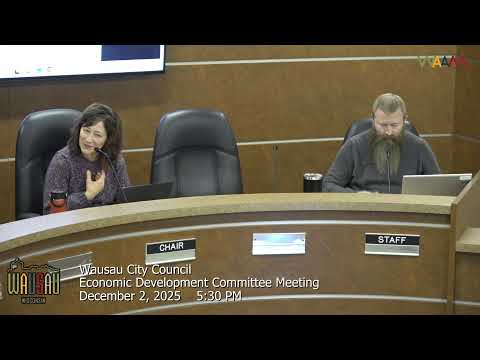
Sam Wessel of the North Central Wisconsin Regional Planning Commission told the City of Wausau Economic Development Committee on Dec. 2 that the city should prepare now for shifting demand in older-adult housing, particularly because of affordability pressures and staffing shortages.
Wessel, who presented the City of Wausau Older Adults Housing Study 2025, said the analysis focuses on three cohorts (ages 55–64, 65–74 and 75-plus) and relies on county population projections, census data and interviews with local stakeholders. "If there's one thing I want you to take away from this presentation is that affordability for the housing itself and then staffing for some of the more ... health-care-oriented facilities and residential facilities are gonna be the top two concerns," Wessel said.
Why it matters: committee members heard that Wausau and Marathon County have a high share of households with incomes under $75,000, which will constrain choices for many older residents. Wessel said the study projects demographic waves—an early demand rise around 2030 driven by baby boomers and another later increase—as well as shifts from owner-occupied to renter-occupied units for the oldest cohort. He also cited an increase in long-term-care bed demand, saying the presentation estimated roughly "485 additional beds by 2030 and another 60 beds by 2040." The consultant cautioned those projections are based on available county-level projections and should be interpreted as scenario-based guidance rather than precise counts.
Committee reaction: Alders raised two recurring concerns. Alder Tierney warned that facilities are already "very understaffed" and questioned the city's capacity to subsidize new development. Alder Killian asked how dependent the recommendations are on city subsidy; Wessel replied that many options do not require direct financial support and emphasized coordination with developers and surrounding jurisdictions. Committee members also raised language- and access-related issues and noted that rehabilitating existing housing and building flexible units could be lower-cost responses than new construction.
What comes next: Wessel said the draft will be shared with the planning commission and the full council, and staff invited committee members to submit comments before the report is finalized. The study is intended as a starting point to guide longer-term planning and funding conversations rather than as a prescriptive program.
Sources: presentation by Sam Wessel, North Central Wisconsin Regional Planning Commission, and committee discussion at the Dec. 2, 2025 Economic Development Committee meeting.