Get email alerts on the Building Code Setbacks topic
No spam. Unsubscribe anytime.
Building Code Council committee says no statewide rulemaking now after debate over side‑yard access
Summary
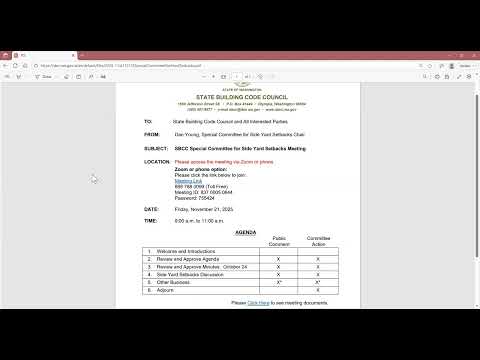
A Building Code Council special committee discussed a petition on side‑yard setbacks and emergency access, debated 3‑foot paths vs. 5‑foot turning radii and pavement/impervious‑surface tradeoffs, and voted to have staff send a response and not pursue immediate statewide rulemaking.
The Building Code Council’s special committee on side‑yard setbacks met to consider a petition seeking emergency rulemaking and, after extended discussion of access for emergency responders, voted to direct staff to prepare a response to the proponent and recommended no immediate state rulemaking.
Committee members spent the bulk of the meeting weighing competing goals: protecting emergency access to rear entrances and keeping requirements flexible enough to preserve recent state goals to increase housing density. Tom Young described recent state laws ‘‘to get more housing built’’ and warned that allowing as many as six units per lot increases the number of narrow access corridors between structures. ‘‘We should try to target’’ minimum usable access, he said, but also acknowledged the legislature’s push for greater land use intensity.
Participants debated technical options. Joe offered a practical framing: ‘‘3 feet might be adequate for a straightaway, but for a return, you might need a 5 foot radius.’’ Several members said that requirement could be a performance standard — a clear width to primary entrances with additional turning area at pivots — rather than a single uniform setback number. Patrick Hanks, who introduced himself on the call as representing the Building Industry Association of Washington, listened but did not press the committee for emergency action.
Other concerns shaped the discussion. Angela, who reviewed fire‑separation distances and permitting realities, warned that requiring paved side‑yard paths could trigger local impervious‑surface limits and drainage or public‑works reviews, and that post‑construction obstructions (fences, stored items) often defeat designed clearances. Micah urged a detailed code analysis before prescriptive changes, noting that IRC and IBC provisions already address some egress and exit‑discharge requirements.
Several members questioned whether the building code is the correct forum for a statewide standard. Jay and Todd argued for harmonizing building, fire and local development codes and for relying on predevelopment meetings, plan reviews and designers’ professional responsibilities to catch conflicts between zoning, insulation encroachments and permitted fixtures such as heat pumps.
By the meeting’s end, the committee agreed to preserve the record of discussion and to let proponents drive any formal code proposals. Todd Biver moved ‘‘to direct the staff to prepare a letter to the council with those recommendations,’’ the motion was seconded and passed by voice vote with no recorded opposition. Dustin said staff would draft the response: ‘‘They are due a response letter from the SBCC, so, I can get working on that.’’
The committee did not direct staff to begin rulemaking; members framed the outcome as a recommendation to memorialize the conversation, inform the petition denial, and allow future, public‑driven code proposals to be considered through the standard code‑development process. The special committee closed after asking staff to synthesize the discussion into a draft letter to the council.
AI generated
The text on this page is AI generated. Summaries, highlights, analysis, and video transcripts are all produced from the original source material.
AI can make mistakes, so if you spot one, and we will fix it for everyone.
Note: the source content is unaltered by us. Any content source we link to, be it a video, an audio recording, or a document, is presented exactly as its publisher released it. That publisher is usually a government body, sometimes an individual official or another organisation.